
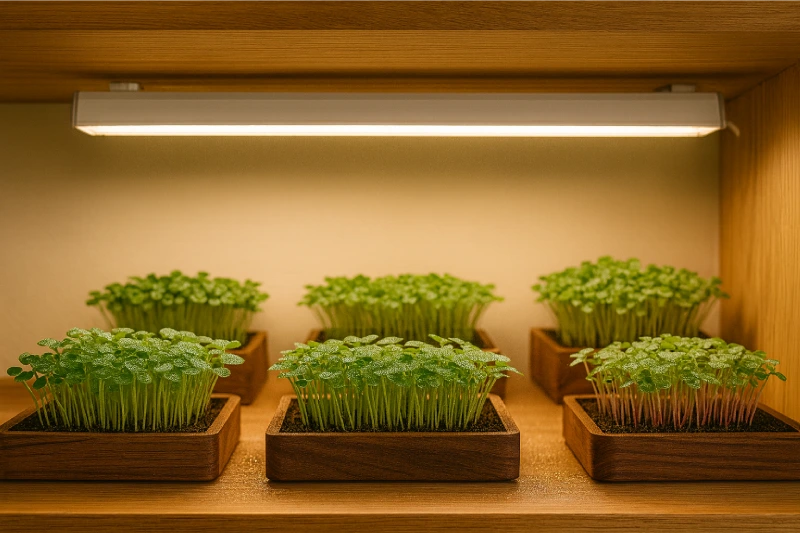
I’ll never forget my reaction the first time I bought microgreens from a grocery store. The tiny plastic clamshell cost $5.99 / £4.99 / €5.50, contained maybe 28 grams (1 ounce) of greens, and was gone in two meals. I stood in my kitchen thinking, “There has to be a better way.” That thought led me down a path that’s completely changed how I approach indoor food growing.
That was about four years ago, early in my indoor gardening journey. I’d been growing herbs with mixed success and was curious about these trendy, expensive little greens I kept seeing at fancy grocery stores and on restaurant plates. I bought seeds on impulse, found a plastic takeout container under my sink, and figured I’d try growing them myself. What happened next surprised me: they actually worked. Seven days after planting radish microgreens, I harvested a handful of intensely flavored, vibrant greens that cost me a few pennies to grow.
I’m Polly, and microgreens have become the foundation of my indoor edible garden. They’re fast, space-efficient, nearly foolproof, and incredibly rewarding. If you’ve never grown anything before, or if you’ve killed every houseplant you’ve ever owned, microgreens are your redemption story waiting to happen. This guide covers everything I’ve learned through years of experimentation, hundreds of trays grown, and more than a few failures along the way.
What Are Microgreens? Understanding the Basics
Before we dive into growing, let’s clarify exactly what microgreens are, because there’s genuine confusion around this.
Microgreens are young vegetable and herb plants harvested 7-21 days after germination, typically when the first true leaves appear. They’re grown in soil or growing medium (not just water like sprouts), and you eat the stem and leaves but not the roots or seeds.
Microgreens vs sprouts: this confusion is everywhere. Sprouts are germinated seeds grown in water with no soil or light, harvested in 2-5 days, and you eat everything including the seed and root. Think mung bean sprouts or alfalfa sprouts. Microgreens are grown longer, in soil/medium with light exposure, and only the above-ground portion is consumed. The growing methods, flavors, textures, and even food safety considerations are completely different.
Microgreens vs baby greens: also different. Baby greens (like “baby spinach” or “spring mix”) are immature versions of regular vegetables, typically harvested at 3-5 weeks. They’re larger than microgreens, less intense in flavor, and grown with more spacing. Microgreens are harvested much younger and grown much more densely.
Growth stages explained: Seeds germinate (2-5 days depending on variety), develop cotyledon leaves (the first seed leaves that emerge), then develop the first set of true leaves (which look like miniature versions of the mature plant leaves). Microgreens are typically harvested right when true leaves appear or shortly after. This is when flavor is most concentrated and nutrition peaks.
Why they’re nutritional powerhouses: Research shows microgreens contain 4-40 times more nutrients by weight than their mature counterparts. A 2012 study from the University of Maryland found that red cabbage microgreens had 40 times more vitamin E and six times more vitamin C than mature cabbage. Cilantro microgreens had three times more beta-carotene than mature cilantro. This isn’t marketing hype—it’s documented science. The plant is putting all its stored seed energy into rapid initial growth, concentrating nutrients in those first leaves.
Flavor intensity is dramatic. Microgreens taste like concentrated versions of their mature plants. Radish microgreens have that sharp, peppery radish bite but more intense. Basil microgreens taste more “basil” than mature basil. This intensity means you need less to flavor dishes, and they work as both food and garnish simultaneously.
Why Grow Microgreens Indoors?
I could give you a dozen reasons, but let me focus on what actually matters from my lived experience.
The cost comparison is absurd. Store-bought microgreens cost $120-200 per kg ($55-90 per pound) / £100-170 per kg / €110-185 per kg in my area. A packet of organic microgreen seeds costs $3-5 / £2.50-4 / €3-5 and grows 450-900 grams (1-2 pounds) of microgreens. One 25×50 cm (10×20 inch) tray yields about 110-170 grams (4-6 ounces) of microgreens. The cost per tray in seeds and supplies is under $2 / £1.50 / €2. You’re looking at 95% cost savings compared to buying them.
I track my expenses obsessively (28-year-old trying to be financially responsible), and microgreens have the best return on investment of anything I grow. I now spend maybe $15-20 / £12-16 / €15-20 monthly on supplies and harvest what would cost $80-120 / £65-100 / €75-110 at stores.
Nutrition at peak harvest. Those nutritional compounds start degrading the moment plants are cut. Store-bought microgreens might be 3-7 days old when you buy them—already losing vitamins. Mine go from tray to plate in under 60 seconds. The nutritional difference is real and measurable. I’ll dive deep into nutrition optimization later, but this immediacy alone justifies home growing.
Speed creates instant gratification. I’m not naturally patient. Waiting 60-90 days for a tomato to ripen tests me. But microgreens? Seven to fourteen days from seed to harvest for most varieties. This rapid turnaround kept me motivated when I was a beginner. Success comes fast enough to maintain enthusiasm while you learn.
Space efficiency is unmatched. My entire microgreens operation occupies 90×60 cm (3×2 feet) of shelf space in my apartment and produces more greens than I can eat. You can grow microgreens on a kitchen counter, bookshelf, or windowsill. No garden needed, no patio required, no outdoor space whatsoever. Perfect for renters, apartment dwellers, or anyone with limited space.
Year-round growing works anywhere. It’s January, it’s snowing, and I just harvested fresh sunflower microgreens. Weather is irrelevant. Climate is irrelevant. You control all conditions indoors. This independence from seasons and geography is empowering in ways I didn’t anticipate.
Food safety and provenance matter more now. Store-bought microgreens have been linked to foodborne illness outbreaks—E. coli, salmonella, listeria. Large-scale production introduces contamination risks from irrigation water, handling, processing facilities, and cross-contamination during transport. When I grow my own, I control everything. Organic seeds, clean water, my hands are the only ones touching them. Zero mystery chemicals, zero questionable growing practices.
Microplastic avoidance is significant. Those plastic clamshells are ubiquitous for store-bought microgreens. Plus, research increasingly shows that plastic packaging, processing equipment, and even plastic mulches used in agriculture contribute microplastics to our food. My microgreens touch no plastic during growing or harvesting—just my reusable trays, soil, and scissors. Every tray I grow is one less plastic container in my life.
Best Microgreens for Beginners
I’ve grown probably 25+ varieties of microgreens over the years. Some were fantastic, others disappointing or difficult. If you’re starting out, begin with these proven winners.
Radish microgreens: Start here. If you grow only one variety to begin, make it radish. They germinate in 2-3 days, are ready to harvest in 7-10 days, tolerate beginner mistakes, and taste amazing—sharp, peppery, and crunchy. Varieties like ‘Daikon’ radish, ‘China Rose’, or mixed radish work beautifully. Seeds are large enough to handle easily, germination rate is near 100%, and they grow vigorously even in less-than-perfect conditions.
I’ve never had radish microgreens fail completely. I’ve had leggy ones (insufficient light), mold issues (overwatering), and pale ones (harvested too early), but they always grew. This forgiveness makes them perfect for learning.
Broccoli microgreens: Nutritious and reliable. These take slightly longer than radish—10-14 days to harvest—but they’re incredibly nutritious and grow consistently well. The flavor is mild broccoli with a slight peppery note. They’re smaller and more delicate than radish but still robust growers.
Broccoli microgreens are among the most studied for nutrition. They’re particularly high in sulforaphane, a compound linked to cancer prevention. Growing them at home means you get maximum sulforaphane content, which degrades rapidly after harvest.
Sunflower microgreens: Substantial and crunchy. These are different from most microgreens—larger, crunchier, more substantial. They taste nutty and slightly sweet, with a satisfying texture. They take longer (8-12 days) and require an extra step (soaking seeds before planting), but they’re worth it.
Sunflower shoots are one of the few microgreens that feel like actual food rather than a garnish. A handful is genuinely filling. I use them like lettuce in sandwiches and wraps.
The catch: you need to buy hulled sunflower seeds specifically for sprouting/microgreens. Regular bird seed or snack sunflower seeds won’t work (they’re roasted or treated).
Pea shoots: Sweet and productive. Pea shoot microgreens (also called “pea tendrils” when you let them grow a bit longer) are sweet, tender, and wildly productive. Seeds are large and easy to handle. They take 10-14 days and grow tall—15-20 cm (6-8 inches) is normal.
The flavor is sweet pea, mild and pleasant. Even people who dislike peas often enjoy pea shoots. They work in both salads and cooked dishes (stir-fries, sautés).
Mustard greens: Spicy and fast. If you like bold flavors, mustard microgreens are fantastic. They’re ready in 7-10 days, grow easily, and pack a spicy punch—more intense than radish. Multiple mustard varieties are available (red, green, various Asian mustards), each with slightly different heat levels.
I use mustard microgreens sparingly because they’re assertive. A small amount adds significant flavor to salads, sandwiches, or as garnish on soups.
Arugula: Peppery and quick. Arugula microgreens taste like concentrated arugula—peppery, slightly nutty, with more bite than mature arugula. They’re ready in 7-10 days and grow reliably. They’re smaller and more delicate than radish but still beginner-friendly.
One note: arugula microgreens have hairy stems, which some people find off-putting texturally. I don’t mind, but worth knowing.
Kale: Nutritious and easy. Kale microgreens (any variety—curly, lacinato, red Russian) are nutritional powerhouses and grow consistently well. They take 10-14 days, have mild kale flavor (less bitter than mature kale), and are loaded with vitamins A, C, and K.
They’re smaller and more delicate than radish or sunflower, but they grow densely and yield well per tray.
Varieties to avoid as a beginner:
Basil is finicky. I struggled with basil microgreens for months. They’re slow (14-21 days), prone to damping off (a fungal disease), and require perfect watering balance. Once I figured them out, they’re delicious, but not beginner-friendly.
Beets are slow and temperamental. They take 14-21 days, germinate unevenly, and the seeds are actually seed clusters (each “seed” contains 2-4 plants), making density control difficult. Beautiful colors (especially red beets with magenta stems), but challenging.
Cilantro can be difficult. Seeds are large and easy to handle, but germination is often spotty (50-70% is normal), and they’re slow (14-18 days). Once established they’re fine, but the germination frustration isn’t beginner-friendly.
Chia and other mucilaginous seeds (flax, and arugula can be problematic too) release a gel-like substance when wet, making them tricky to grow in soil. They work better in soil-free methods, but that’s an added complication for beginners.
Essential Equipment and Supplies
The beauty of microgreens is you need very little equipment. Don’t let anyone convince you to buy expensive specialized systems—basic supplies work beautifully.
Growing containers/trays are your foundation. I use standard 25×50 cm (10×20 inch) nursery trays (the kind used in garden centers). These come in two types:
- With drainage holes: Better for soil-based growing, allows excess water to drain
- Without holes (solid bottom): Works for soil or soil-free growing, holds water for bottom-watering
I started with one of each (they nest together—solid tray underneath catches drainage or holds water). Each tray costs $1-3 / £0.80-2.50 / €1-3. Buy several so you can stagger plantings.
Alternative containers: recycled food containers (takeout containers, salad boxes, shallow produce containers), aluminum baking pans (cheap and disposable), or any shallow container 5-7 cm (2-3 inches) deep. Must have good drainage or you’ll manage water carefully to avoid rot.
Growing mediums—soil vs soil-free is a real choice:
Potting soil/seed starting mix: Organic potting soil or seed-starting mix works perfectly. I use organic potting mix, which costs about $8-12 / £7-10 / €8-12 for a bag that does 10-15 trays. Seed starting mix is lighter and cleaner but more expensive. Avoid heavy garden soil—it compacts and doesn’t drain well.
Pros: Familiar, readily available, provides some nutrients, works for all varieties Cons: Messy at harvest (soil clings to roots), heavier, requires disposal/composting after use
Coconut coir: Compressed bricks of coir expand when soaked in water, creating a soil-like growing medium. One brick ($3-5 / £2.50-4 / €3-5) makes enough for many trays. It’s sustainable (coconut byproduct), nearly sterile (low disease risk), and lightweight.
Pros: Clean, lightweight, sustainable, rehydrates easily, minimal mess Cons: Provides no nutrients (not an issue for microgreens), can dry out quickly, requires bottom-watering setup
Hemp mats or hydroponic grow pads: Thin mats of compressed plant fibers specifically for microgreens. You soak them, place in trays, sprinkle seeds, and grow. Very clean, minimal mess.
Pros: Cleanest method, no soil at all, easy disposal/composting, consistent results Cons: More expensive per tray ($0.50-1.50 / £0.40-1.20 / €0.50-1.40 each), sometimes harder to find, some varieties prefer soil
I’ve used all three extensively. Soil is cheapest and works for everything but is messiest. Coir is my current favorite for most varieties—good balance of clean, affordable, and effective. Hemp mats are great for gifts or when I want zero mess, but cost adds up.
Seeds must be specifically for microgreens/sprouting. This is critical. Regular garden seeds are often treated with fungicides not meant for food crops. You need:
- Seeds labeled “for microgreens” or “sprouting seeds”
- Organic certification helps ensure no treatments
- High germination rate (look for 90%+ if listed)
- Fresh seeds (check dates)
Where to buy: Johnny’s Seeds, True Leaf Market, Mumm’s Sprouting Seeds, Mountain Valley Seed Company, or reputable online sources. Many sell sampler packs—perfect for beginners trying varieties. Seeds cost $3-8 / £2.50-7 / €3-8 per packet depending on variety and quantity.
Don’t cheap out on seeds from unknown sources. Food safety matters, and questionable seeds can carry pathogens or be chemically treated.
Spray bottle or watering can with fine rose. Watering microgreens requires a gentle touch. I use a simple spray bottle ($1-2 at any store) for misting and a small watering can with a fine rose (the sprinkler head) for bottom watering. Avoid heavy streams that disturb seeds or knock over young seedlings.
Light requirements: Natural vs grow lights. This is probably the biggest question beginners have.
Natural light (windowsill growing): Possible for some varieties, but limited. You need a south-facing window (north-facing in Southern Hemisphere) with at least 4-6 hours of direct sun. Even then, results are mixed—microgreens may be leggy (stretched) or pale. I’ve successfully grown radish, sunflower, and peas on a bright windowsill, but broccoli, kale, and mustard struggled.
Grow lights (recommended): Change everything. I resisted buying grow lights initially (expense, setup hassle), but once I did, success rate and quality improved dramatically. Microgreens need lots of light to develop color, compact growth, and full flavor.
I use simple LED shop lights—the 120 cm (4-foot) T5 or T8 fixtures that cost $25-40 / £20-35 / €25-40 each. Full-spectrum white LEDs work perfectly. Each fixture lights 1-2 trays. I mounted them under shelves in my apartment, suspended by chain so I can adjust height.
Run lights 12-16 hours daily, positioned 10-15 cm (4-6 inches) above trays. Closer is better for compact growth. Timers ($10-15 / £8-12 / €10-15) automate this perfectly.
Optional equipment that helps:
Blackout dome or cover: Many growers cover seeds for the first 2-5 days (the “blackout” period) to encourage germination and initial growth. I use an upside-down tray, cardboard, or an actual humidity dome. Not essential but improves results.
Small fan: Improves air circulation, reduces mold/fungal risk, strengthens stems. I run a small desk fan on low for 2-4 hours daily near (not directly on) my microgreens.
Shelving: Wire shelving units ($30-60 / £25-50 / €30-55) create vertical growing space. I fit 4-6 trays on a 60×120 cm (2×4 foot) shelf unit, multiplying growing capacity.
Cost breakdown for getting started:
Minimal setup:
- 2 trays: $2-6 / £1.50-5 / €2-6
- Small bag of potting soil: $5-8 / £4-7 / €5-8
- 2-3 seed packets: $6-15 / £5-12 / €6-15
- Spray bottle: $1-2 / £0.80-1.50 / €1-2
- Total: $14-31 / £11-26 / €14-31
Recommended setup (what I wish I’d started with):
- 4-6 trays: $4-18 / £3-15 / €4-18
- Potting soil or coir: $8-15 / £7-12 / €8-15
- 5-6 seed varieties: $15-35 / £12-30 / €15-35
- LED grow light: $25-40 / £20-35 / €25-40
- Timer: $10-15 / £8-12 / €10-15
- Spray bottle and watering can: $5-10 / £4-8 / €5-10
- Total: $67-133 / £54-112 / €67-133
This gets you everything needed for reliable, year-round microgreens production in any space.
Soil vs Soil-Free: Which Method is Better?
I get asked this constantly. The truth: both work, each has advantages, and your choice depends on priorities.
Soil method advantages:
- Most forgiving for beginners
- Works for all varieties
- Familiar—everyone understands soil
- Retains moisture well
- Provides trace nutrients (though microgreens don’t need much)
- Cheap and readily available
Soil method disadvantages:
- Messy at harvest (soil clings to roots and stems)
- Heavier to move
- Requires disposal/composting after use
- Can harbor fungus gnats if kept too wet
- More difficult to achieve restaurant-quality “clean” appearance
Soil-free (hydroponic mats/coir) advantages:
- Very clean at harvest—roots are easily rinsed
- Lightweight and easy to handle
- Less prone to fungal issues if method is correct
- More “professional” appearance
- Easier disposal (less bulk)
- Can often reuse growing water
Soil-free disadvantages:
- Slightly less forgiving (requires attention to moisture)
- Initial setup/understanding takes more effort
- Growing mats cost more per use than soil
- Some varieties (sunflowers, peas) prefer soil depth
- Bottom-watering setup required
My personal evolution: I started with soil because it felt safe and familiar. Results were good, but harvest was messy and I spent time washing soil from roots. I experimented with coir next and was surprised how well it worked—cleaner harvest, good growth, easy to manage. Now I use coir for most varieties (radish, broccoli, kale, mustard) and soil for larger seeds (sunflower, peas) that benefit from more depth.
Recommendations by experience:
- Absolute beginners: Start with soil. It’s forgiving and you’ll learn fundamentals without worrying about moisture management.
- After 2-3 successful soil trays: Try coir or hemp mats. You’ll appreciate the cleaner process.
- Long-term: Use what works for your situation. I know growers who only use soil, others who only use hydroponic mats. Both produce excellent microgreens.
Step-by-Step: Growing Microgreens in Soil
This is the method I recommend for first-timers. Let’s walk through it in detail using radish microgreens as our example.
1. Prepare your container. Take your 25×50 cm (10×20 inch) tray with drainage holes. If using a container without holes, be extra careful with watering (it’s possible but less forgiving).
2. Add soil. Fill the tray with 2.5-4 cm (1-1.5 inches) of moist potting soil. Not soaking wet, not dry—like a wrung-out sponge. I usually moisten soil in a bucket before adding to trays, which is easier than trying to wet it after it’s in the tray. Pat soil down gently to create an even, level surface. Don’t pack it hard—soil should be fluffy enough for roots to penetrate easily.
3. Calculate seed amount. This is where beginners often go wrong—too few seeds give sparse coverage, too many create overcrowding and mold. For a 25×50 cm tray:
- Radish: 30-40 grams (1-1.5 ounces)
- Broccoli: 20-30 grams (0.75-1 ounce)
- Sunflower (hulled): 170-225 grams (6-8 ounces)
- Peas: 170-280 grams (6-10 ounces)
- Mustard/arugula/kale: 15-25 grams (0.5-0.75 ounce)
Seeds should cover about 50-70% of soil surface after spreading—not so dense they’re piled on each other, not so sparse you see lots of bare soil. Seed packets often provide density recommendations.
4. Spread seeds evenly. I pour seeds into my hand and sprinkle them across the soil surface, trying for even distribution. Don’t stress about perfect spacing—slightly uneven is fine. Seeds should mostly be in a single layer, though some overlap is okay.
For large seeds (sunflower, peas), you can place them more deliberately. For tiny seeds (broccoli, kale), broadcasting (scattering) works fine.
5. Press seeds into soil. Use your hand, a flat object, or another tray to gently press seeds into contact with soil. You’re not burying them—just ensuring good seed-to-soil contact for moisture uptake. For very small seeds (broccoli, mustard), you can sprinkle a very thin layer of soil over them (2-3mm), but it’s not essential.
6. Water gently. Using your spray bottle, mist the entire surface until soil is evenly moist and seeds are wet. Or pour water into the bottom tray (if using nested trays) and let soil absorb from below. Avoid heavy watering that displaces seeds or creates puddles.
7. Cover for blackout period. Place an upside-down tray, cardboard, or humidity dome over your planted tray. This blocks light and helps maintain moisture during germination. Most varieties benefit from 2-4 days of darkness. Weight can help—I sometimes place a 1-1.5 kg (2-3 pound) weight on top of the cover (like a book or water bottle). This gentle pressure encourages seeds to push roots into soil and can produce more compact growth.
Place your covered tray somewhere warm (18-22°C / 65-72°F is ideal). You don’t need light during blackout.
8. Check daily during blackout. Lift the cover once daily to check moisture and germination. Soil surface should stay moist. If drying, mist lightly. Most seeds germinate in 2-4 days. You’ll see tiny sprouts pushing up.
9. Remove cover and expose to light. Once you see most seeds have germinated (tiny stems and leaves visible), remove the cover and weight. Place the tray under grow lights (10-15 cm / 4-6 inches away, 12-16 hours daily) or in your brightest window. This is typically day 3-5 depending on variety.
Initial growth will be pale yellow or white—this is normal. Chlorophyll develops within 12-24 hours of light exposure, and plants will green up rapidly.
10. Water as needed. Check trays 1-2 times daily. Soil should stay consistently moist but not waterlogged. I prefer bottom watering at this stage—pour water into the bottom tray and let soil absorb from below. This prevents disturbing delicate seedlings and reduces risk of damping off disease.
For radish, I typically water once daily. For denser plantings or warmer conditions, twice daily may be needed. Microgreens grow fast and use water quickly.
11. Monitor growth. Over the next 5-10 days (variety dependent), microgreens will grow rapidly. You’ll see cotyledon leaves first, then true leaves begin emerging. Stems elongate, color deepens, and plants fill the tray.
Watch for issues: If growth is pale and leggy, increase light. If you see white fuzz at the soil surface, increase air circulation (fan) and reduce watering slightly—this might be mold (bad) or could be root hairs (normal and harmless—they look fuzzy but not truly fuzzy like mold). If plants topple over at soil line, that’s damping off disease—increase air circulation, reduce moisture, and start over.
12. Harvest when ready. For radish, this is typically 7-10 days from planting, when plants are 5-7 cm (2-3 inches) tall and true leaves are just emerging or newly emerged. Harvest in the morning for best flavor and crispness. Use clean scissors to cut stems about 1 cm (half an inch) above soil level.
13. Dispose of spent soil and roots. After harvest, spent soil and root mat can be composted or added to outdoor garden beds. Don’t reuse soil for microgreens—it’s depleted and may harbor pathogens.
Step-by-Step: Growing Microgreens Soil-Free
Growing without soil is cleaner and often preferred once you’ve mastered basics. I’ll describe the coir method (my favorite soil-free option).
1. Prepare coconut coir. Buy compressed coir bricks. Break off a chunk (roughly fist-sized for one 25×50 cm tray) and place in a bucket. Add warm water—coir will expand dramatically. One small chunk becomes 4-6 cups of fluffy, soil-like medium. Let it expand fully (5-10 minutes), then fluff it with your hands. It should be moist but not dripping—squeeze out excess water if needed.
2. Set up double-tray system. Place your solid-bottom tray (no drainage) on the bottom. Place your tray with drainage holes on top, nested inside. This allows bottom-watering—water in the bottom tray is absorbed through drainage holes.
3. Add coir to top tray. Fill the drainage-hole tray with 2-3 cm (0.75-1.25 inches) of prepared coir. Pat down gently to create even surface. Coir should be evenly moist throughout.
4. Spread seeds. Use the same seed densities as soil method. Spread evenly across coir surface. For coir, I find slightly lower density works better than soil—aim for 50-60% coverage rather than 70%.
5. Mist seeds. Spray seeds with water to ensure they’re moist and in contact with coir. Don’t soak—just mist well.
6. Cover for blackout. Same as soil method—cover tray to block light. Weight is optional but can help. Place in warm location.
7. Bottom water during blackout. Instead of misting from above, pour water (250-500ml / 1-2 cups) into the bottom solid tray. Coir absorbs water through drainage holes. Check daily—if bottom tray is dry, add more water. If water remains after 30 minutes, you’ve added too much (not a disaster, just don’t add more until it’s absorbed). Keep coir moist but not waterlogged.
8. Remove cover and add light. When germination occurs (usually day 2-4), remove cover and place under lights or in window. Microgreens will green up within hours.
9. Continue bottom watering. Check bottom tray twice daily. If dry, add 250-500ml (1-2 cups) of water. Coir dries faster than soil, so attention matters. The goal: coir stays evenly moist, never soaked or dry. You’ll develop a feel for how much water your setup needs.
10. Monitor and grow. Same as soil method. Watch for leggy growth (more light needed), yellowing (possibly too little water or nutrients—though nutrients aren’t usually an issue in the short microgreen growth cycle), or mold (improve air circulation).
11. Harvest. Coir makes harvesting cleaner. Cut microgreens just above the coir surface. Roots stay in the coir mat, which peels away easily. Rinse harvested greens briefly to remove any coir particles, and they’re ready to eat—much cleaner than soil-grown.
12. Disposal. Dump coir and root mat into compost. Coir is fully compostable. Rinse trays and they’re ready for reuse immediately.
Alternative: Hemp/hydroponic mats. Process is nearly identical to coir. Soak mat according to package directions (usually 30 seconds to 2 minutes), place in tray, squeeze out excess water, spread seeds, proceed as above. Even cleaner than coir but costs more per use.
Light Requirements: Natural vs Grow Lights (The Honest Truth)
This is where I see most beginners struggle and where advice online is often misleading. Let me be direct based on real experience.
Can you grow microgreens on a windowsill? Sometimes, but don’t expect great results unless you have ideal conditions.
What “ideal” means: South-facing window (north in Southern Hemisphere) with zero obstructions, receiving at least 5-6 hours of direct, unfiltered sunlight daily. Not bright indirect light—actual direct sun hitting the tray. Even then, results vary by season. Winter sun at northern latitudes won’t give the same intensity as summer sun.
My windowsill experiments: I grew radish, sunflower, and pea shoot microgreens on my south-facing windowsill in spring. Results: Acceptable but not great. Radish grew well enough—stems were longer than ideal (leggy) but flavor was good. Sunflowers were pale yellow-green instead of vibrant green. Pea shoots were okay. Broccoli and kale were disappointing—stretched badly, very pale, minimal flavor.
In winter, even my best window couldn’t produce acceptable microgreens. Days are too short, sun angle is too low, intensity is too weak. Everything was leggy and pale.
Which varieties tolerate lower light: If you insist on trying windowsill growing, stick to:
- Radish (most tolerant)
- Sunflower (acceptable but color suffers)
- Peas (will stretch but grow)
Avoid windowsill for:
- Broccoli, kale, mustard, arugula (all become unacceptably leggy)
- Any variety you want restaurant-quality appearance from
Grow lights transform results. I resisted this truth for months, trying to make natural light work. When I finally bought a simple LED shop light and grew my first tray of broccoli microgreens under it, the difference was shocking. Deep green color, compact growth (half the height of windowsill versions), intense flavor, professional appearance. I immediately understood why commercial growers use lights exclusively.
What lights to buy: Simple full-spectrum LED shop lights work perfectly. I use 120 cm (4-foot) T5 fixtures that cost $25-40 / £20-35 / €25-40 each. Each fixture handles 1-2 microgreen trays depending on how close you position them.
Look for:
- Full-spectrum or 5000-6500K color temperature (cool white)
- LED (energy efficient, low heat)
- At least 2000-4000 lumens
- Simple plug-in models (no complicated ballasts)
Avoid:
- Incandescent or fluorescent (hot, inefficient)
- “Blurple” grow lights (purple LED ones)—they work but the color is harsh and makes it hard to assess plant health
- Expensive specialized systems—not necessary for microgreens
Light positioning matters enormously. Position lights 10-15 cm (4-6 inches) above trays. Closer produces more compact, intensely colored microgreens. Too far (30+ cm / 12+ inches) and you get stretching. I adjust height as plants grow, maintaining that 10-15 cm distance.
Duration: 12-16 hours daily. I run lights on timers for 14 hours daily. More than 16 hours offers minimal benefit and wastes electricity. Less than 12 hours produces leggier growth. Consistency matters—same schedule daily.
Light intensity and variety: Some varieties need more intense light than others. Radish and sunflower tolerate moderate light. Broccoli, kale, and mustard need strong light for best color and compact growth. If you have one light source, grow demanding varieties closer and tolerant ones farther away.
Energy costs are minimal. My 40-watt LED running 14 hours daily uses about 0.56 kWh per day, or 17 kWh monthly. At average electricity rates ($0.12-0.15 / £0.10-0.13 / €0.11-0.14 per kWh), that’s $2-2.50 / £1.70-2.20 / €1.85-2.40 monthly per light. Negligible compared to the value of microgreens produced.
Bottom line: If you’re serious about growing microgreens with consistent, high-quality results, invest in grow lights. If you want to experiment casually with forgiving varieties, try a bright windowsill. But don’t blame the method or your skills if windowsill results disappoint—it’s a light issue.
Daily Care and Maintenance
Once seedlings are established, ongoing care is straightforward. Consistency matters more than perfection.
Watering is your primary daily task. Microgreens need consistent moisture from seed to harvest. Check trays every morning, and again in evening if conditions are warm or dry.
How to tell if watering is needed:
- Soil/coir method: Stick your finger 1-2 cm (half-inch) into the growing medium. If dry, water. If moist, skip watering.
- Visual check: Surface looks dry or lighter in color
- Weight check: Lift the tray—dry trays are noticeably lighter
How to water:
- Bottom watering (preferred for established microgreens): Pour 250-500ml (1-2 cups) of water into the bottom tray. Growing medium absorbs water through drainage holes. Wait 30 minutes—if water remains, you’ve added too much (let it absorb or pour off excess). If all water is absorbed quickly, you can add a bit more.
- Top watering/misting: For very young seedlings (first 2-3 days after uncovering), I mist from above with a spray bottle. Once plants are 2-3 cm (1 inch) tall, I switch to bottom watering to avoid disturbing plants and reduce disease risk.
Frequency varies: In my conditions (20-22°C / 68-72°F room temperature, moderate humidity, under grow lights), I water once daily. Warmer, drier conditions may require twice daily. Cooler, humid conditions might need every other day. You’ll develop a rhythm based on your environment.
Overwatering vs underwatering:
- Overwatering: Soggy medium, standing water, yellowing stems at soil line, sudden collapse (damping off), mold growth, foul smell
- Underwatering: Dry medium, wilted plants, slow growth, crispy/browning leaf edges
Microgreens are fairly forgiving of slight underwatering (they’ll perk up after watering) but intolerant of overwatering (which causes disease). When in doubt, err slightly on the drier side.
Air circulation prevents problems. Stagnant air encourages mold and fungal diseases. I run a small desk fan on low speed for 2-4 hours daily, positioned so it creates gentle air movement near (not directly blasting) the trays. This also strengthens stems, producing sturdier microgreens.
Alternatively, growing near natural air movement (not cold drafts) helps—near a doorway, under an air vent, or anywhere air naturally circulates.
Temperature monitoring is mostly passive. Ideal range is 18-22°C (65-72°F), which is typical indoor temperature. Most microgreens tolerate 15-24°C (60-75°F) fine. Below 15°C (60°F), growth slows. Above 24°C (75°F), disease risk increases and some varieties may taste more bitter.
I don’t actively control temperature—I just note if my growing area feels unusually warm or cool and adjust expectations accordingly. If growing in a warm room in summer, I might harvest a day earlier before bitterness develops.
Light is on a timer. I set it and forget it—14 hours daily. The only adjustment I make is raising lights as microgreens grow taller, maintaining that 10-15 cm (4-6 inches) distance.
Monitoring for issues takes 30 seconds. When I water, I quickly scan trays:
- Color: Should be vibrant green (or appropriate color for variety). Pale yellow indicates insufficient light.
- Growth pattern: Compact and upright is good. Stretched and floppy indicates too little light or too much heat.
- Mold/fungus: White fuzzy growth on surface (different from white root hairs, which are fine and hair-like). If seen, increase air circulation and reduce watering slightly.
- Pests: Rarely an issue indoors, but I check for fungus gnats (tiny flying insects) or aphids (clusters of tiny bugs on stems)
Total time investment: After initial planting (15 minutes), I spend maybe 5 minutes daily across all trays—watering check, quick visual inspection, adjusting lights if needed. Harvesting adds 5-10 minutes per tray. It’s remarkably low-maintenance.
Troubleshooting Common Problems
Even with good care, issues arise. Here’s what I’ve encountered and how to fix it.
White fuzz on the surface: Mold or root hairs? This confuses everyone initially because they look similar at first glance.
Root hairs are normal—fine, white, hair-like projections from the stem at soil level. They look slightly fuzzy but are individual fine threads when examined closely. They appear when humidity is high and are harmless—actually a sign of healthy roots seeking moisture. No action needed.
Mold is fuzzy, cotton-like, can be white or grayish, and often has a musty smell. It grows on the surface of the medium or on fallen seed hulls. It spreads and can be problematic.
To distinguish: Root hairs appear at the stem-soil junction. Mold appears on the surface away from stems, on seed hulls, or spreading across the medium. Root hairs don’t spread; mold does.
If it’s mold: Increase air circulation immediately (add fan or increase fan duration). Reduce watering frequency slightly. Remove any visible seed hulls or debris. If mild, you can harvest on schedule and the harvested greens are fine (mold is on the surface, not on the edible stems/leaves). If severe, start over with better ventilation and less water.
Seeds not germinating or patchy germination:
- Old seeds (check date, try fresher seeds)
- Seeds dried out during germination (keep consistently moist)
- Seeds too cold (need 18-22°C / 65-72°F)
- Some varieties (cilantro especially) naturally have lower germination rates (60-70% is normal)
- Seeds planted too deep (should be barely covered or just pressed into surface)
Solution: Ensure consistent moisture and warmth during blackout period. Buy fresh seeds from reputable sources. Accept that some varieties won’t have 100% germination.
Leggy, pale, stretched growth: Insufficient light is 95% of the cause. Stems are long, weak, and pale yellow or light green. Plants flop over.
Solution: Increase light intensity (move closer to light source) or duration (add 2-4 hours). If using natural light, this likely won’t work—invest in grow lights. For current batch, harvest what you can (flavor may be reduced but they’re edible), and improve light for next planting.
Damping off disease: Seedlings suddenly collapse and die at soil level. Stems look pinched or water-soaked where they meet the soil. This fungal disease thrives in cold, wet, stagnant conditions.
Solution: Increase air circulation, reduce watering frequency, ensure growing area is warm enough. Once it strikes, there’s no cure—remove affected plants and improve conditions for survivors. Prevention is key: good air movement, proper watering (not too much), and warm temperatures.
Foul smell from tray: Root rot from overwatering. Medium is waterlogged, roots are suffocating and rotting, and anaerobic bacteria create the smell.
Solution: For current tray, it’s probably too late—harvest anything salvageable and start over. Next time, water less frequently, ensure drainage, and don’t let trays sit in standing water.
Slow growth:
- Insufficient light (most common)
- Too cold (below 15°C / 60°F)
- Old seeds with low vigor
- Planting density too high (overcrowding)
Solution: Increase light, check temperature, use fresh seeds, reduce seed density on next planting.
Yellow microgreens: Before light exposure: Normal—they’ll green up within 12-24 hours of light. After several days of light: Insufficient light intensity. Move closer to light source. With brown/crispy edges: Underwatering or too much direct heat. Check watering schedule and ensure lights aren’t too close.
Seeds flying everywhere during harvest: Some seed hulls (especially sunflower) remain attached to cotyledon leaves and go everywhere when you cut. Annoying but harmless.
Solution: Mist plants lightly just before harvesting—helps seed hulls stay put. Harvest over a large container or sink to contain mess. Remove seed hulls during washing/sorting after harvest.
Fuzzy/hairy stems (arugula especially): Normal for some varieties. The stems have fine hairs that are natural, not mold. Some people find the texture unpleasant; others don’t notice. Nothing to fix—it’s just the variety characteristic.
Bitter taste:
- Harvested too late (past prime)
- Heat stress (growing area too warm)
- Water stress (allowed to dry out)
- Some varieties are naturally more bitter (mustard, arugula)
Solution: Harvest earlier, maintain cooler temperatures if possible, water consistently, and choose varieties suited to your taste preferences.
Harvesting and Storage
Proper harvesting maximizes flavor, nutrition, and appearance. It’s simple, but details matter.
When to harvest: Timing varies by variety, but general rule: Harvest when first true leaves have just emerged or are just about to emerge. This is typically:
- Radish: 7-10 days
- Broccoli, kale, arugula, mustard: 10-14 days
- Sunflower: 8-12 days
- Peas: 10-14 days (can go longer for larger shoots)
Visual cues: Plants should be 5-10 cm (2-4 inches) tall with fully developed cotyledon leaves and true leaves just emerging (true leaves look like tiny versions of mature plant leaves—different from rounded cotyledons).
Don’t wait too long—microgreens past prime develop tougher stems, more bitter flavor, and diminished nutrition. When in doubt, harvest a test handful, taste it, and decide if it’s ready or needs another day.
Time of day matters: Harvest in the morning for best flavor and nutrition. After plants have been under lights all night, they’re crisp and hydrated. By late afternoon, especially under lights, they can be slightly wilted. The difference is subtle but real.
Harvesting technique: Use clean scissors or a sharp knife. I prefer scissors for control. Cut stems approximately 1 cm (half an inch) above the soil/growing medium line. You want to avoid cutting too low (get growing medium in your harvest) or too high (waste edible stem).
Cut in sections—I do a few handfuls at a time, placing cut microgreens in a bowl. Work systematically across the tray.
For soil-grown microgreens, some soil particles will cling to roots still in the tray—this is normal. Just try to cut cleanly above the soil line.
For soil-free methods, harvest is cleaner—roots stay in the medium with minimal mess.
Washing: To wash or not? This is debated in microgreens communities. Here’s my approach:
I always wash mine. Even indoors, microgreens accumulate dust, potentially have seed hulls, and might have soil particles. Washing also crisps them up and ensures any mold spores (if mold was present on the surface) are removed.
How I wash: Place cut microgreens in a large bowl of cool water. Swish gently, let sit for 1-2 minutes. Any debris sinks or floats. Lift microgreens out (don’t pour—that dumps debris back on them) and place in a salad spinner. Spin until mostly dry, then spread on clean kitchen towels or paper towels to air-dry for 15-20 minutes before storing.
Some people don’t wash, arguing it removes nutrients and flavor. If you’re confident your growing process was clean and you’re eating immediately, skipping washing is fine. But for storage or if there’s any doubt about cleanliness, wash them.
Removing seed hulls: Some varieties (especially sunflower) retain seed hulls attached to leaves. These are edible but can be bitter or tough. I remove most during washing—they float or sink separately from the greens. Some stubborn ones stay attached, which is fine—I eat them or pick them off during use.
Storage methods: Immediate use: Best option nutritionally. Harvest, rinse if desired, and eat within 15-30 minutes.
Short-term (2-3 days): Place clean, DRY microgreens in an airtight container lined with paper towels (to absorb any moisture). Store in refrigerator. The drier they are before storage, the longer they last. Check daily and remove any wilted pieces.
Medium-term (4-7 days): Use the same method but be more careful about moisture. Some people store microgreens in containers with damp (not wet) paper towels, others prefer completely dry. I do dry storage and mist very lightly if they seem to be drying out after a few days.
Delicate varieties (broccoli, kale, arugula) last 3-5 days maximum. Hardier ones (sunflower, pea shoots, radish) can go 5-7 days.
Freezing (not recommended for most): Microgreens don’t freeze well—they become mushy when thawed. The exception: if you’re adding them to smoothies or cooked dishes where texture doesn’t matter, freezing works. Spread on a tray, freeze solid, transfer to freezer bags.
Best practice: Harvest only what you’ll use in 2-3 days. With staggered plantings, you’ll always have fresh trays ready, eliminating storage concerns. This is how I operate—I harvest Monday’s salads on Monday, Thursday’s salads on Thursday, etc.
Variety-by-Variety Deep Dive
Now that you understand the fundamentals, let’s dive into specific varieties with detailed growing notes, flavor profiles, and usage suggestions based on my experience.
Radish Microgreens
Days to harvest: 7-10 days Flavor: Sharp, peppery, spicy—like radish but more intense Appearance: Purple-pink stems, green leaves, sometimes blushed with purple Growing notes: Easiest of all microgreens. Large seeds germinate quickly (2-3 days), grow vigorously, tolerate beginner mistakes. Daikon radish produces white stems; red radish varieties give pink-purple stems. Seed density: 30-40g per 25x50cm (10x20in) tray Common issues: Rarely any. Occasionally leggy if light is weak. Nutrition: High in vitamins A, B, C, E, and K. Contains antioxidants and enzymes. Usage: Salads, sandwiches, tacos, sushi, as garnish on soups. The peppery bite adds character to mild dishes. Polly’s notes: This is where I started and where I recommend everyone start. If you can’t grow radish microgreens successfully, something fundamental is wrong (usually light). They’re also delicious—my most-used variety.
Broccoli Microgreens
Days to harvest: 10-14 days
Flavor: Mild broccoli flavor, slightly peppery, fresh Appearance: Small, delicate, bright green leaves on thin stems Growing notes: Very reliable growers. Seeds are small, so handle carefully. Need good light to develop deep color. Prone to white root hairs (normal, not mold). Seed density: 20-30g per standard tray Common issues: Can get leggy with insufficient light. Root hairs confuse beginners. Nutrition: Extremely high in sulforaphane (cancer-fighting compound), vitamins C and K. Usage: Salads, smoothies, wraps, as garnish. Mild enough to add to nearly anything. Polly’s notes: These are my go-to for nutrition. Research shows broccoli microgreens have 10-100 times more sulforaphane than mature broccoli. I add them to everything, including morning smoothies where I don’t taste them.
Sunflower Microgreens
Days to harvest: 8-12 days Flavor: Nutty, slightly sweet, crunchy Appearance: Large leaves, thick stems, impressive size Growing notes: Require extra steps (pre-soaking seeds 8-12 hours, using heavier blackout weight), but worth it. Need deeper growing medium (4-5cm) than most varieties. Must use hulled sunflower seeds specifically for sprouting. Seed density: 170-225g per tray (much heavier than others) Common issues: Seed hulls remain attached to leaves (annoying but harmless). If not soaked, germination is poor. Nutrition: High in protein, healthy fats, vitamins B and E, minerals including zinc and iron. Usage: Like lettuce—sandwiches, wraps, salads. Substantial enough to be a salad base rather than just an addition. Polly’s notes: These feel like actual food, not just a garnish. A handful is genuinely filling. They’re worth the extra effort, and once you’ve done it a few times, it becomes routine.
Pea Shoots
Days to harvest: 10-14 days (can go longer for larger shoots) Flavor: Sweet pea flavor, tender, pleasant Appearance: Tall (15-20cm), curling tendrils, larger leaves than most microgreens Growing notes: Easy and vigorous. Seeds are large and easy to handle. Benefit from pre-soaking (8-12 hours) for better germination. Can harvest twice—first cutting regrows for a second, smaller harvest. Seed density: 170-280g per tray Common issues: Can get tall and tangled. Some seeds may mold during soaking (discard any that smell off). Nutrition: Good protein, vitamins A, C, and K, folate. Usage: Salads, stir-fries (they handle light cooking well), Asian dishes, wraps. Beautiful curling tendrils make elegant garnish. Polly’s notes: These are forgiving and delicious. Everyone likes pea shoots—even people skeptical of microgreens. The regrowth aspect is cool but second harvest is never as good as first.
Mustard Microgreens
Days to harvest: 7-10 days Flavor: Spicy, peppery, assertive—more intense than radish Appearance: Small, delicate leaves, often with purple or red tinting Growing notes: Easy and fast. Various mustard varieties available (red, green, Asian mustards) with varying heat levels. Small seeds, so handle carefully during seeding. Seed density: 15-25g per tray Common issues: Few. Occasionally slow germination if old seeds. Nutrition: High in vitamins A, C, K, antioxidants, and phytonutrients. Usage: Use sparingly due to intensity—as accent in salads, on sandwiches, in Asian dishes. Pairs well with rich foods that can handle the spice. Polly’s notes: A little goes a long way. I use mustard microgreens when I want boldness. They’re too intense for my taste as a salad base but perfect mixed with milder greens or as garnish on dishes that need a kick.
Arugula Microgreens
Days to harvest: 7-10 days Flavor: Peppery, nutty, concentrated arugula flavor Appearance: Small serrated leaves, hairy stems (normal for variety) Growing notes: Easy and fast. Seeds are small. Stems have natural fine hairs that some people dislike texturally. Seed density: 15-20g per tray Common issues: Hairy stems are off-putting to some. Seeds can be mucilaginous (produce gel-like substance), making spacing tricky. Nutrition: Vitamins A, C, K, calcium, iron. Usage: Salads, pizza topping (add after baking), pasta, sandwiches. Pairs well with Italian dishes. Polly’s notes: I love the flavor but find the hairy stems slightly unpleasant. I still grow them regularly because the flavor is fantastic. If texture bothers you, try other varieties.
Kale Microgreens
Days to harvest: 10-14 days Flavor: Mild kale flavor, less bitter than mature kale, fresh Appearance: Small, dense leaves, bright green Growing notes: Easy and reliable. Various kale types work (curly, lacinato, red Russian). Need good light for best color. Seed density: 15-25g per tray Common issues: Can be leggy with insufficient light. Nutrition: Exceptionally high in vitamins A, C, K, calcium, iron, antioxidants. Usage: Smoothies (undetectable if blended), salads, wraps, as garnish. Mild enough for nearly any dish. Polly’s notes: These are my “sneak nutrition into everything” microgreens. I add them to smoothies, blend into pestos, mix into egg dishes. The mild flavor means they’re versatile.
Cilantro/Coriander Microgreens
Days to harvest: 14-21 days (slow) Flavor: Fresh cilantro flavor, slightly citrusy Appearance: Delicate, lacy leaves, thin stems Growing notes: Slower and trickier than most. Germination is often 60-70% (many seeds won’t sprout). Benefit from pre-soaking seeds or crushing seed shells slightly to improve germination. Seed density: 40-50g per tray (higher due to poor germination rate) Common issues: Patchy germination, slow growth, can be leggy. Nutrition: Vitamins A, C, K, antioxidants. Usage: Mexican dishes, Asian cuisine, salads, salsas, guacamole. Anywhere you’d use regular cilantro. Polly’s notes: I grow these occasionally despite the challenges because the flavor is worth it. If you hate cilantro (genetic soapy-taste thing), skip these entirely. If you love cilantro, the microgreen version is even more flavorful.
Basil Microgreens
Days to harvest: 14-21 days Flavor: Intense basil flavor, sweet and aromatic Appearance: Small green leaves, purple stems (for purple basil varieties) Growing notes: Finicky. Prone to damping off disease. Need excellent air circulation, careful watering (not too much), and warmth. Worth growing once you have experience with easier varieties. Seed density: 10-15g per tray Common issues: Damping off disease kills seedlings. Slow growth. Sensitive to overwatering. Nutrition: Vitamins A, K, antioxidants, essential oils. Usage: Italian dishes, caprese salads, pizza, pasta, as garnish. Polly’s notes: I killed three trays before successfully growing basil microgreens. They’re delicious but demanding. Not for beginners. Once you master watering and air circulation, they’re manageable.
Varieties I tried and didn’t love:
Beets: Beautiful magenta stems and veins, but slow (14-21 days), germination is uneven (seed clusters are weird), and flavor was just okay—earthy but not particularly special.
Chia: Mucilaginous nightmare in soil. They release so much gel that seeds float and clump. Work better in soil-free methods but still challenging.
Amaranth: Beautiful colors (red, purple, green) but slow, tiny seeds are hard to handle, and flavor was fairly bland.
Your preferences will differ. Part of the fun is experimenting with varieties to find your favorites.
Using Microgreens in the Kitchen
This is where your growing efforts pay off. Microgreens are versatile, flavorful, and elevate nearly any dish.
Salads are the obvious application. I use microgreens as the entire salad base or mixed with regular lettuces. They’re more flavorful than typical salad greens, so you need less dressing. A simple salad of sunflower and radish microgreens with lemon juice, olive oil, salt, and pepper is genuinely delicious—the microgreens provide enough flavor that you don’t need much else.
Mix varieties for complexity: radish for spice, sunflower for substance, broccoli for mild background, mustard for kick.
Sandwiches and wraps benefit immensely. Replace or supplement lettuce with microgreens—sunflower especially works well due to size and crunch. A handful of pea shoots in a wrap adds freshness. Radish or mustard microgreens on a turkey sandwich add peppery bite.
Garnishes transform presentation. A small pile of colorful microgreens on soup, pasta, pizza, grain bowls, or any plated dish makes it look restaurant-quality. Use contrasting colors—red radish stems against pale soups, green microgreens on tomato-based dishes.
Smoothies hide nutrition. Milder varieties (broccoli, kale, sunflower) blend into fruit smoothies without detectably affecting flavor. I add a large handful (30-50g) to morning smoothies—massive nutrition boost with zero taste impact if blended well with fruit.
Eggs and microgreens are perfect together. Scrambled eggs, omelets, frittatas, egg sandwiches—all benefit from microgreens added just before serving (heat wilts them, so add after cooking). The freshness cuts the richness of eggs beautifully.
Avocado toast becomes gourmet. Top with radish or arugula microgreens. The visual appeal and flavor contrast is significant.
Tacos and Mexican dishes: Cilantro microgreens are obvious, but radish microgreens also work beautifully—they add crunch and spice that complements Mexican flavors.
Asian dishes: Pea shoots are traditional in Chinese cuisine. Mustard microgreens work in stir-fries or as garnish on noodle dishes (add after cooking to preserve crunch).
Pasta and grain bowls: Top finished dishes with microgreens just before serving. Basil microgreens on Italian pasta, arugula or mustard on grain bowls, sunflower shoots on rice bowls.
Pesto and sauces: Blend microgreens into pesto in place of or alongside basil. Sunflower, arugula, or basil microgreens work well. The flavor is intense, so you’ll use less.
Pizza: Add delicate microgreens (arugula, basil) after pizza comes out of oven. They wilt slightly from residual heat but maintain freshness—common in upscale pizza restaurants.
Flavor pairings I’ve learned:
- Radish microgreens: Rich foods (cheese, cream sauces, avocado), fish, eggs, tomatoes
- Sunflower: Everything—they’re mild enough to work anywhere you’d use lettuce
- Broccoli: Smoothies, Asian dishes, as garnish on soups
- Pea shoots: Asian cuisine, spring dishes, light pasta, stir-fries
- Mustard/arugula: Bold, rich foods that can handle spice—burgers, steak, strong cheeses
- Kale: Smoothies, grain bowls, hearty dishes
- Basil: Italian dishes, tomatoes, mozzarella, Mediterranean cuisine
- Cilantro: Mexican, Thai, Vietnamese cuisine
Presentation tips:
Microgreens are delicate—add them last, don’t cook them (except pea shoots), and handle gently. They’re meant to be fresh and vibrant.
For garnishing, I create small piles or scatter loosely—avoid dumping a clump in the center of a plate. Think about color contrast—purple radish stems pop against white or pale foods.
For salads, I toss gently just before serving to avoid crushing delicate leaves.
Maximizing Nutrition from Your Microgreens
The nutritional density of microgreens is well-documented—that University of Maryland study I mentioned earlier wasn’t an isolated finding. But what I’ve learned through research and experimentation is that when and how you harvest and consume your microgreens dramatically affects how much of that nutrition you actually get.
Harvest Timing: The Nutrient Peak
There’s a precise window when microgreens contain maximum nutrition. It’s not when they’re biggest—it’s when the first true leaves have just emerged or are about to emerge.
Here’s what happens: During germination and early growth, the plant is mobilizing all the nutrients stored in the seed and concentrating them into rapid growth. At the cotyledon stage (first seed leaves), nutrient density is high. When true leaves emerge, that’s the peak—the plant has mobilized everything but hasn’t yet started putting energy into stem elongation and full-size leaf development.
Wait too long, and nutrient density per gram starts declining. The plant is getting larger but not proportionally more nutritious—it’s diluting those concentrated nutrients across more plant mass. Plus, some vitamins (especially vitamin C) begin degrading as the plant matures.
My harvesting strategy: I harvest most varieties right when I see the first tiny true leaves beginning to unfold. For radish, that’s day 7-9. For broccoli, day 10-12. I don’t wait for maximum size—I harvest for maximum nutrition and flavor.
The difference is noticeable. Radish microgreens harvested at day 7 are intensely peppery and vibrant. The same tray at day 12 is larger but has tougher stems, slightly bitter flavor, and less intensity. I’ve done side-by-side tastings enough times to trust this.
Light Exposure Before Harvest
Light exposure in the final 24-48 hours before harvest significantly impacts nutrient content, particularly chlorophyll, vitamin C, and certain phytonutrients.
Research shows that microgreens with maximum light exposure (intensity and duration) in the days before harvest have measurably higher vitamin C and chlorophyll content. This makes sense—photosynthesis is actively producing compounds right up until harvest.
What I do: I keep my lights on the full 14-hour schedule right up until the morning of harvest. Some growers even increase light duration to 16 hours for the final two days before harvest, though I haven’t tested whether this makes a meaningful difference.
What’s clear: Don’t reduce light or move trays away from lights before harvest. Those final hours of photosynthesis matter.
Time of Day: Morning Harvest Wins
I mentioned harvesting in the morning earlier, but here’s why it matters nutritionally:
Plants undergo different processes during light and dark periods. During the day (under lights), they’re photosynthesizing—producing sugars and various compounds. At night, they’re using stored energy for growth and other processes.
By morning, after a full night of rest, plants are maximally hydrated, crisp, and have the highest concentration of certain compounds. By late afternoon or evening, especially under lights, some nutrient degradation has occurred and plants may be slightly stressed.
The difference: I’ve harvested the same tray of radish microgreens—half in the morning, half in the evening—and done a blind taste test. Morning harvest was crisper, more flavorful, and stayed fresh in the refrigerator a day longer. The nutritional difference isn’t something I can measure at home, but research supports morning harvest for peak vitamin content.
I harvest between 7-9 AM, right after my lights have been on for an hour or two. Plants are awake and perky.
The Washing Trade-Off
Here’s a dilemma: washing removes potential contaminants but also removes some nutrients, particularly water-soluble vitamins like vitamin C and some B vitamins.
Studies on vegetables show that washing can remove 10-25% of vitamin C and smaller amounts of other water-soluble nutrients. The longer you wash and the more vigorously, the more is lost.
But not washing means potential exposure to dust, mold spores, or any contaminants from your growing environment.
My approach: I wash quickly and gently. Swish in cool water for 30-60 seconds, lift out (don’t dump—dumping recirculates debris back onto the greens), and spin dry immediately. I figure I’m losing maybe 10-15% of some vitamins, but gaining peace of mind about cleanliness. The tradeoff is worth it for me.
If you’re growing in pristine conditions (new soil, clean water, no visible mold), you could skip washing if you’re eating immediately. But for storage or if there’s any doubt, wash quickly.
To minimize nutrient loss: use cold water (warm water leaches more nutrients), wash briefly, and dry immediately (sitting in water leaches more nutrients).
Storage Degradation: The 15-Minute Rule
This is perhaps the most important nutrition lesson I’ve learned: Nutrients in microgreens start degrading the moment they’re harvested.
Research on leafy greens shows that vitamin C can decline 10-50% in the first 24 hours after harvest, depending on storage conditions. The same applies to microgreens. Other vitamins (A, E, K) are more stable but still decline over days.
Enzyme activity also changes after harvest. Remember that sulforaphane in broccoli microgreens I mentioned? Its precursor compounds need the plant’s enzymes to convert into active sulforaphane. Once the plant is cut and starts deteriorating, enzyme activity changes, affecting how much sulforaphane your body actually absorbs.
The 15-minute rule: Ideally, I harvest and eat within 15 minutes. This isn’t always practical, but it’s my gold standard. For salads, I harvest just before preparing the meal. For smoothies, I harvest and blend immediately. For sandwiches, I harvest and assemble within minutes.
When this isn’t possible, I minimize time and optimize storage:
- Harvest, wash quickly, dry thoroughly, and refrigerate immediately in an airtight container
- Keep temperature at 1-4°C (34-39°F)—as cold as your refrigerator goes without freezing
- Use within 2-3 days maximum
Every day in storage, I’m losing nutrients. By day 7, even well-stored microgreens have lost a significant portion of their vitamin content. They’re still more nutritious than most vegetables, but they’re not the superfoods they were at harvest.
This is why store-bought microgreens, while better than nothing, can’t compare to home-grown. By the time you buy them, they might be 5-7 days post-harvest. You’re getting a fraction of the nutrition.
Raw vs Cooked: Heat and Nutrients
Most microgreens should be eaten raw for maximum nutrition. Heat destroys or reduces many vitamins (especially C and some B vitamins) and can deactivate beneficial enzymes.
That said, some compounds become more bioavailable with light cooking. Beta-carotene (vitamin A precursor) absorption increases with gentle heat. And certain phytonutrients are more stable than you’d think.
My guidelines:
- Always raw: Broccoli (to preserve sulforaphane), radish, mustard, arugula, kale, sunflower
- Can handle light cooking: Pea shoots (traditional in stir-fries)
- Add after cooking: Basil, cilantro—add to hot food after removing from heat so they wilt from residual warmth but aren’t actually cooked
When I use microgreens in hot dishes, I add them at the very end, off heat. This preserves most nutrition while integrating them into the dish.
For example, with pasta, I toss microgreens in after draining, letting the residual heat wilt them slightly. With soup, I add them to individual bowls after serving, not to the pot. With stir-fries, I remove the pan from heat, add pea shoots, toss for 10 seconds, and serve immediately.
Pairing with Fats: Absorption Matters
Many of the beneficial compounds in microgreens—vitamins A, E, K, and various carotenoids—are fat-soluble. Your body needs dietary fat present to absorb them effectively.
Eating microgreens plain or in a fat-free smoothie means you’re not absorbing these compounds efficiently. Add fat, and bioavailability increases dramatically—some studies show 2-5x improvement in carotenoid absorption when fat is present.
How I pair microgreens with fats:
- Salads: Always dress with olive oil, avocado oil, or include avocado, nuts, cheese, or eggs
- Smoothies: Add nut butter (1-2 tablespoons), chia seeds, flax oil, or coconut oil
- Sandwiches/wraps: Include cheese, avocado, hummus, or mayo
- Garnishes: Drizzle finished dishes with olive oil when topping with microgreens
This isn’t complicated—just ensure when you eat microgreens, there’s some healthy fat in the meal. Even a small amount (1 teaspoon of oil, a few nuts, a slice of avocado) makes a measurable difference in what your body actually absorbs.
Which Varieties for Which Nutrients
Different microgreens concentrate different nutrients. If you’re targeting specific nutritional goals, grow strategically:
For sulforaphane (cancer-fighting compound):
- Broccoli microgreens (highest—up to 100x more than mature broccoli)
- Kale, cabbage, cauliflower microgreens (all cruciferous)
- Radish, mustard, arugula (also contain significant amounts)
For vitamin C:
- Red cabbage microgreens (exceptionally high—40x mature cabbage in some studies)
- Mustard, arugula
- Broccoli, kale
For vitamin E:
- Sunflower microgreens (very high—40x more than mature sunflower leaves)
- Amaranth
For vitamin K:
- Kale microgreens (extremely high—one serving exceeds daily requirements)
- Chard, beet microgreens
- Broccoli, arugula
For beta-carotene (vitamin A precursor):
- Cilantro microgreens (surprisingly high—3x mature cilantro)
- Kale, chard
- Basil, parsley
For protein:
- Pea shoots (relatively high for a vegetable—about 3-4g per 100g)
- Sunflower microgreens
For calcium and iron:
- Kale, chard, beet microgreens
- Amaranth
For overall nutrient density:
- Broccoli (consistent winner across multiple studies)
- Red cabbage
- Radish
- Kale
I rotate varieties partly for flavor diversity but also for nutritional variety. A week of broccoli for sulforaphane, then radish for vitamin C and spice, then sunflower for vitamin E and substance, then kale for vitamin K. This rotation ensures I’m getting a broad spectrum of nutrients rather than optimizing for just one.
Growing Conditions That Boost Nutrients
How you grow microgreens affects their nutritional content. Small adjustments in growing conditions can increase nutrient density:
Light intensity: Higher light intensity (within reason—not burning the plants) increases vitamin C, chlorophyll, and antioxidant content. This is why grow lights produce more nutritious microgreens than weak windowsill light. Keep lights close (10-15 cm / 4-6 inches) for maximum benefit.
Light spectrum: Full-spectrum white LEDs produce microgreens with higher nutrient content than single-spectrum lights. Blue and red wavelengths are both important for different compounds. This is why I use full-spectrum fixtures rather than red-blue “blurple” lights.
Moderate stress: Slight environmental stress can trigger plants to produce more protective compounds (antioxidants, phytonutrients). This doesn’t mean abusing your plants, but slightly cooler temperatures (18-20°C / 64-68°F instead of 22-24°C / 72-75°F) or allowing the growing medium to approach dry (not fully dry) between waterings can boost certain compounds. I don’t do this deliberately—I mention it because perfect conditions might not always produce the most nutritious microgreens.
Seed quality: Fresh, high-quality seeds from reputable sources produce more vigorous plants with better nutrient content. Old seeds or low-quality seeds may germinate but produce weaker plants with lower nutrient density. This is why I buy fresh seeds annually rather than using old packets.
Growing medium: Organic soil or coir versus non-organic doesn’t seem to make a huge difference for microgreens (they’re harvested too young to accumulate much from the medium). However, some trace minerals from soil might be absorbed. I use organic potting mix or coir and figure it doesn’t hurt.
No fertilizer needed: Microgreens don’t need fertilizer—they’re living off seed energy. Adding fertilizer doesn’t increase nutrition and might introduce contaminants. Skip it entirely.
The Sprouts vs Microgreens Debate (Nutrition)
I touched on the growing differences earlier, but nutritionally, sprouts and microgreens are different too.
Sprouts (grown in water, 2-5 days, eaten whole including seed and root):
- Very high in enzymes (because you’re eating the whole germinated seed)
- High in certain B vitamins
- Lower in vitamins A, C, K (less developed leaves means less of these vitamins)
- Higher food safety risk (warm, moist, dark conditions during sprouting can harbor bacteria)
Microgreens (grown in soil/medium with light, 7-21 days, only stem and leaves eaten):
- Very high in vitamins A, C, E, K (from developed leaves and photosynthesis)
- High in chlorophyll and phytonutrients (from light exposure)
- High in specific compounds like sulforaphane (cruciferous microgreens)
- Lower food safety risk (light exposure and air circulation reduce bacterial growth)
Both are nutritious, but microgreens are generally more nutrient-dense overall, especially for vitamins and antioxidants. Sprouts have their place (I occasionally sprout mung beans or lentils), but for everyday nutrition, microgreens are superior.
The other factor: I trust the food safety of my microgreens more than sprouts. Multiple sprout-related foodborne illness outbreaks have occurred because the warm, moist sprouting conditions are ideal for pathogens. Microgreens grown with good air circulation and light are far less risky.
Bioavailability: Getting Nutrients Into Your Body
Growing nutritious microgreens is only half the equation—your body needs to absorb those nutrients.
Factors that improve bioavailability:
Eating with fat (as mentioned): Essential for fat-soluble vitamins and carotenoids. Always pair microgreens with some healthy fat.
Chewing thoroughly: Breaking down plant cell walls releases nutrients. I chew microgreens well rather than swallowing quickly. For smoothies, blend thoroughly—high-speed blending breaks cell walls better than chewing, potentially increasing nutrient availability.
Eating raw (mostly): Heat destroys some nutrients but can improve absorption of others (like beta-carotene). For most microgreens, raw is best. The exception: if you have digestive issues with raw vegetables, lightly wilting microgreens with gentle heat might make them easier to digest and actually improve overall nutrient absorption for you personally.
Combining with vitamin C: Vitamin C enhances iron absorption from plant sources. Many microgreens contain both, but adding lemon juice to salads or including high-vitamin-C fruits in smoothies with microgreens boosts iron absorption.
Gut health: Your gut microbiome affects how well you absorb nutrients. Eating microgreens regularly might actually improve gut health (fiber, prebiotics), creating a positive cycle where you absorb nutrients better over time.
Fresh over stored: Enzyme activity in fresh microgreens might aid digestion and absorption. This is speculative, but it’s another reason I prefer eating microgreens fresh rather than stored.
Home-Grown vs Store-Bought: The Real Difference
I buy store-bought microgreens occasionally when I’m between harvests or traveling. The difference is stark.
Nutritional differences:
- Age at consumption: Store-bought might be 5-10 days post-harvest. Mine go from tray to plate in under an hour. Vitamin C alone could be 30-50% higher in my fresh-harvested microgreens.
- Growing conditions: I don’t know how store-bought microgreens were grown—light intensity, growing medium quality, seed quality, or handling practices. Mine are grown under optimal conditions with organic seeds and controlled practices.
- Handling: Store-bought microgreens are cut, washed (nutrient loss), packaged, transported, sit in warehouses and stores. Each step degrades nutrition. Mine experience one quick rinse and immediate consumption.
Taste differences: Store-bought microgreens often taste milder, less vibrant. My home-grown radish microgreens are aggressively peppery. Store-bought ones are… polite. The flavor difference mirrors the nutritional difference—both are declining together.
Quality differences: I’ve bought store-bought microgreens that had yellowing leaves, wilted stems, or even slight sliminess (early rot). Mine are perfect every time because I harvest at peak and use immediately.
Cost (obviously): $5.99 / £4.99 / €5.50 for 28 grams versus $0.50 / £0.40 / €0.50 for 170 grams home-grown. It’s not even close.
The verdict: If you have access to very fresh, locally-grown microgreens from a farmer’s market (harvested that morning), they might be comparable to home-grown. But typical grocery store microgreens are a pale imitation of fresh-harvested home-grown ones, both nutritionally and in flavor.
Polly’s Personal Nutrition Strategy
Here’s how I actually use microgreens for maximum nutrition in my daily life:
Morning smoothie (every day): I harvest 40-60 grams of broccoli or kale microgreens, blend with frozen berries, banana, spinach, nut butter (fat for absorption), and plant milk. This delivers massive sulforaphane, vitamins, and antioxidants in a form that’s quick and delicious. I don’t taste the microgreens at all with the fruit, but I know they’re there working.
Lunch salad (4-5 days per week): Base of sunflower microgreens (substantial), topped with radish and mustard microgreens (flavor), dressed with olive oil and lemon (fat for absorption, vitamin C for iron absorption). I add whatever protein I have—leftover chicken, chickpeas, hard-boiled eggs. This salad is so flavorful that I use minimal dressing.
Dinner garnish (most days): Whatever I’m making—pasta, grain bowls, soup, tacos—I top with appropriate microgreens. Basil on Italian food, cilantro on Mexican, pea shoots on Asian dishes, or just radish/arugula on everything else. This adds 10-20 grams of microgreens to dinner with zero effort.
Snacks: Microgreens on avocado toast, in wraps, or on crackers with cheese.
Total daily intake: I’m eating 80-120 grams (3-4 ounces) of microgreens daily when I’m on top of my growing schedule. Some days more, some days less, but it averages to about 700-800 grams weekly.
The nutritional impact is real. I track my diet loosely (nutrition app), and microgreens consistently contribute 50-100%+ of my daily vitamin K, 40-80% of vitamin C, 30-50% of vitamin A, plus significant amounts of folate, vitamin E, and various minerals. And that’s not counting all the phytonutrients, antioxidants, and compounds like sulforaphane that aren’t even tracked in nutrition databases.
I’ve also noticed subjectively (not scientifically provable, but my experience) that I feel better, have more stable energy, and get sick less often since making microgreens a daily habit. Could be placebo, could be the nutrition, could be other lifestyle factors—but I’m not stopping to find out.
The key to my strategy: Make it effortless. I grow enough that I’m never rationing microgreens or trying to stretch them. I harvest what I need when I need it. The abundance mentality—knowing I have more growing and ready in a few days—means I actually use them generously rather than hoarding them in the fridge where they lose nutrition.
Succession Planting for Continuous Harvests
The biggest mistake I made early on was planting one or two trays, harvesting them, and then having nothing for two weeks while the next batch grew. Or planting too many at once and having more microgreens than I could eat before they declined in the fridge.
Succession planting—staggered planting at intervals—solves this perfectly. It ensures you always have fresh microgreens ready without waste or gaps.
The Concept: Staggered Timing
The idea is simple: instead of planting all your trays at once, plant them on different days so they mature at different times.
Example: If radish microgreens take 8 days from planting to harvest, and you plant one tray every 4 days, you’ll harvest a fresh tray every 4 days indefinitely. You’ll always have one tray ready, one tray mid-growth, and one tray just planted.
Scale this across multiple varieties and you have fresh microgreens of different types available continuously.
Polly’s Schedule: What Actually Works
It took me about six months of experimentation to dial in a schedule that works for my consumption and lifestyle. Here’s my current system:
Monday: Plant one tray of radish (8-day variety) Wednesday: Plant one tray of broccoli (12-day variety)
Friday: Plant one tray of sunflower (10-day variety) Following Monday: Plant another tray of radish Following Wednesday: Plant another tray of broccoli (Pattern continues)
This gives me:
- Fresh radish every 7-8 days (Monday plantings)
- Fresh broccoli every 12-13 days (Wednesday plantings)
- Fresh sunflower every 10-11 days (Friday plantings)
I’m planting 3 trays per week, harvesting roughly 3 trays per week (though on different days depending on variety), and I always have 6-9 trays at various stages of growth.
Why this schedule works for me:
- I consume about 100-120 grams of microgreens daily. Three trays per week (each yielding 110-170 grams / 4-6 ounces) gives me 330-510 grams weekly, which matches my consumption when accounting for waste and sharing with friends.
- The varieties I chose (radish, broccoli, sunflower) are my favorites and cover different nutritional needs—sulforaphane from broccoli, vitamin C from radish, protein and vitamin E from sunflower.
- Monday/Wednesday/Friday planting schedule is easy to remember and fits my work schedule.
- If I miss a planting day (life happens), it’s not catastrophic—I just have slightly less a week later.
How Many Trays Do You Need?
This depends on your consumption rate. Let me break down the math:
Light consumption (30-50g / 1-2 oz daily):
- 210-350g weekly
- Plant 2-3 trays per week
- Maintain 4-6 trays in rotation
Moderate consumption (70-100g / 2.5-3.5 oz daily – my level):
- 490-700g weekly
- Plant 3-5 trays per week
- Maintain 6-12 trays in rotation
Heavy consumption (120-150g / 4-5 oz daily – families or serious enthusiasts):
- 840-1050g weekly
- Plant 5-7 trays per week
- Maintain 12-18 trays in rotation
Single person experimenting: Start with 2 trays per week. It’s better to under-plant initially—you can always increase. Over-planting leads to waste, which is discouraging.
Families: Scale up. A family of four might need 4-6 trays weekly if everyone eats microgreens regularly.
Rotating Varieties: Avoiding Monotony
Eating only radish microgreens every day gets boring fast. I rotate through 3-4 varieties regularly and experiment with others occasionally.
My core rotation (always growing):
- Radish (fast, reliable, peppery flavor)
- Broccoli (nutrition powerhouse, versatile)
- Sunflower (substantial, different texture)
Secondary rotation (I cycle through these):
- Kale (when I want extra nutrition in smoothies)
- Pea shoots (when I want something mild and sweet)
- Arugula (when I want peppery greens for salads)
Occasional experiments:
- Mustard (intense flavor)
- Basil (special occasions, summer Italian cooking)
- Cilantro (when I’m cooking lots of Mexican or Asian food)
I keep 2-3 core varieties growing continuously and swap the third or fourth slot based on mood and what I’m cooking that week.
This variety rotation means:
- Different flavors keep meals interesting
- Different nutritional profiles ensure broad nutrient intake
- If one tray fails (occasionally happens), I still have other varieties
- I can tailor upcoming harvests to my meal plans
Keeping Records: Why It Matters
I resisted this initially—it felt too Type A, too complicated. But once I started tracking plantings, my success rate and consistency improved dramatically.
What I track (simple notebook):
- Date planted
- Variety
- Seed amount used
- Expected harvest date (based on variety typical timing)
- Actual harvest date
- Yield (approximate—I don’t weigh precisely, just note if it was full tray, half tray, etc.)
- Notes (problems, particularly good/bad growth, experiments)
Example entry: Oct 14 – Radish – 35g seeds – Harvest expected Oct 22 – Actual harvest Oct 21 – Full tray, excellent growth, very peppery
Why this helps:
- I know exactly when to expect harvests. I glance at my notebook Monday morning and see “broccoli ready Wednesday, radish ready Friday.” I plan meals accordingly.
- I track patterns—if broccoli consistently takes 13 days instead of 12 in my setup, I adjust expectations.
- I identify problems early—if three trays in a row have poor germination, I know to check seed freshness or change something.
- I optimize seed amounts—if I’m consistently getting sparse coverage with 30g radish seeds, I increase to 35g next time.
- I remember what works—six months later, I can look back and see “sunflower with pre-soak, 48-hour blackout = excellent” and repeat that success.
This doesn’t need to be complicated. I use a small spiral notebook, one page per month, simple handwritten entries. Takes 30 seconds per planting. The payoff in consistency and learning is enormous.
Avoiding Overwhelm and Shortage
The two failure modes of succession planting:
Overwhelm: You plant too many trays, they all mature at once, you have 500 grams of microgreens ready simultaneously, you can’t eat them all, they sit in the fridge declining, you feel wasteful and guilty, you stop growing.
Solution: Start small. Plant fewer trays than you think you need. It’s better to run out occasionally and adjust upward than to waste harvests. Once you dial in your consumption rate, you can scale up confidently.
Also, stagger your planting days. Don’t plant all Monday—plant Monday/Wednesday/Friday. This naturally spreads harvest timing.
Shortage: You forget to plant for two weeks, suddenly you have no microgreens, you lose momentum, your routine is broken.
Solution: Set reminders. I have recurring phone reminders: “Monday 7 PM – Plant microgreens,” “Wednesday 7 PM – Plant microgreens,” “Friday 7 PM – Plant microgreens.” Takes 15 minutes per planting. The reminder ensures I don’t forget even during busy weeks.
Also, keep backup. I always have at least one tray that’s 2-3 days from harvest. If I forgot to plant last week, I’m not completely out—I have something coming soon, which buys me time to get back on schedule.
Vacation Adjustments: Planning Ahead
Vacations disrupt succession planting. Here’s how I handle it:
Short trips (3-5 days):
- I plant extra trays the week before leaving so I have multiple trays ready when I return
- I harvest everything mature before leaving (even if slightly early)
- Trays that are mid-growth when I leave either (a) get a thorough watering and survive fine, or (b) I ask a friend to water once, or (c) I accept they’ll die and restart when I return
- I don’t plant anything the few days before leaving—no point starting trays I can’t maintain
Long trips (1-2 weeks):
- I harvest everything before leaving
- I either (a) don’t plant anything new for 2 weeks before the trip and restart when I return, or (b) plant trays that will be ready right when I return (timing is tricky but possible)
- I accept there will be a gap in fresh microgreens—I just ramp back up when I’m home
Extended absence (3+ weeks):
- Complete shutdown. I harvest everything, clean trays, and start fresh when I return. Trying to maintain succession through a long absence isn’t worth the stress.
The key: Don’t stress about perfection. Succession planting is a rhythm, not a rigid system. Missing a week or having a gap isn’t failure—it’s life. You just resume the pattern when you’re able.
After vacations or breaks, I typically restart with just one or two trays, let them succeed, then add more trays back into rotation over the following week. This gentle ramp-up is less overwhelming than trying to immediately return to full production.
The Mental Shift: Abundance Mindset
Once succession planting is dialed in, something shifts mentally. You stop treating microgreens as precious because you know more are always coming.
I used to ration microgreens, using tiny amounts to stretch a harvest because I didn’t know when I’d have more. Now I pile them generously on salads, add huge handfuls to smoothies, and give them away to friends because I know another tray is ready in two days.
This abundance mindset makes microgreens actually useful in daily cooking rather than a special-occasion garnish. They become a staple, like lettuce or spinach, that you use freely.
And counterintuitively, abundance mindset reduces waste. When you’re never scrambling or rationing, you’re also never over-harvesting and storing too much. You harvest what you need when you need it, fresh from the tray, and the rest stays growing until you’re ready.
Succession planting creates this abundance. It’s the difference between microgreens as a hobby experiment and microgreens as a genuine food source integrated into your life.
Advanced Tips and Experiments
Once you’ve mastered the basics and have a succession schedule working, you can start experimenting with techniques that optimize growth, boost yields, or just satisfy curiosity.
Pre-Soaking Seeds: When and Why
Some seeds benefit from pre-soaking before planting. Soaking jump-starts germination by softening the seed coat and activating enzymes inside the seed.
Which seeds to pre-soak:
- Sunflower: Essential. Hulled sunflower seeds have had their outer shell removed, leaving a thin inner seed coat. Soaking for 8-12 hours dramatically improves germination rate (from 60-70% to 90%+).
- Peas: Highly recommended. Peas have hard seed coats. Soaking for 8-12 hours speeds germination by 1-2 days and improves evenness.
- Beets: Helpful. Beet “seeds” are actually seed clusters with thick, corky coverings. Soaking 8-12 hours helps.
- Cilantro: Can help. Cilantro naturally has spotty germination (60-70%). Some growers soak or even crush seed hulls slightly to improve rates.
Which seeds NOT to soak:
- Small seeds (radish, broccoli, kale, mustard, arugula): They germinate quickly without soaking. Soaking makes them clumpy and hard to spread evenly. Just plant dry.
- Mucilaginous seeds (chia, flax, basil): They produce gel when wet, making them impossible to handle if pre-soaked.
How to pre-soak:
- Place seeds in a bowl or jar
- Cover with room-temperature water (use 2-3x more water than seeds—they’ll absorb a lot)
- Let sit 8-12 hours (I do overnight)
- Drain well using a fine-mesh strainer
- Rinse briefly to remove any fermentation smell (seeds should smell fresh, not funky)
- Plant immediately—don’t let soaked seeds dry out
My experience: Sunflower without soaking: patchy germination, weak growth, frustrating. Sunflower with soaking: even germination, vigorous growth, excellent results.
Peas without soaking: germination takes 4-5 days, uneven. Peas with soaking: germination in 2-3 days, very even.
For seeds that benefit from it, pre-soaking is worth the minor extra effort.
Weight During Blackout: The Pressure Technique
Some growers place weight on top of covered trays during the blackout period. The gentle pressure encourages roots to push down into the growing medium and can produce more compact, sturdy growth.
How to do it: After covering your planted tray (with an upside-down tray or cover), place 1-1.5 kg (2-3 pounds) of weight on top. I use a large water bottle, a book, or even another tray filled with water. The weight should be evenly distributed, not crushing one side.
Which varieties benefit:
- Sunflower: Definitely. The weight helps those large seeds establish good root contact and produces sturdier, more compact shoots.
- Peas: Helpful. Encourages stronger root development.
- Radish, broccoli, mustard: Marginal benefit. These grow vigorously anyway, but some growers swear weight produces slightly more compact growth.
Important notes:
- Don’t use excessive weight (more than 2 kg / 4-5 pounds). You want gentle pressure, not crushing.
- Remove weight when you remove the blackout cover (when germination is complete). Continuing weight during the growth phase can damage young plants.
- If using weight, check daily to ensure it’s not causing problems (seeds pushed into medium too deeply, uneven pressure creating bare spots).
My experience: I use weight on sunflower trays always—it makes a noticeable difference in stem thickness and sturdiness. For other varieties, I sometimes use it, sometimes don’t. The difference is subtle enough that I don’t stress about it.
Experiment yourself. Grow two identical trays—one with weight, one without—and compare results. Some growers see significant benefits, others see minimal difference. Growing conditions vary enough that what works in one setup might not matter in another.
Rare and Unusual Varieties: What I’ve Tried
Beyond the common microgreens, there’s a whole world of unusual varieties. Some are worth it, others are novelties.
Shiso (Perilla):
- Japanese herb, aromatic, unique flavor (minty, basil-like, slightly spicy)
- Slow (18-21 days), finicky germination, small yields
- Beautiful purple-red color
- Verdict: Delicious but challenging. Grow if you love Japanese cuisine and have patience.
Amaranth:
- Gorgeous colors (red, purple, green varieties available)
- Mild flavor, slightly earthy
- Slow (14-18 days), tiny seeds are difficult to handle
- High in protein and minerals
- Verdict: Beautiful garnish, okay flavor, mediocre difficulty-to-reward ratio for me.
Fennel:
- Mild anise/licorice flavor
- Slow (14-18 days)
- Wispy, delicate appearance
- Verdict: If you like fennel flavor, these are nice. I don’t use fennel enough to justify growing them regularly.
Celery:
- Intense celery flavor—more than you’d expect from something so small
- Very slow (18-25 days), tiny seeds, finicky
- Verdict: Flavor is great for soups and Bloody Marys, but the long growing time and difficulty aren’t worth it for me when I can just buy celery.
Red cabbage:
- Stunning purple-red stems
- Nutritionally exceptional (40x vitamin E of mature cabbage)
- Flavor is mild cabbage, slightly peppery
- Growing difficulty similar to broccoli (easy)
- Verdict: Worth growing. I rotate these in occasionally for the color and nutrition.
Wheat grass and barley grass:
- These are technically microgreens but used differently (juicing, not eating whole)
- I tried them once out of curiosity
- Growing is easy, but I don’t have a juicer and don’t want one
- Verdict: Skip unless you’re into juicing.
Nasturtium:
- Peppery, spicy—similar to radish but floral
- Large seeds, easy to grow
- Slow (12-16 days)
- Verdict: Delicious, beautiful orange/red flowers if you let them grow longer. Worth trying.
Popcorn shoots:
- Yes, actual popcorn kernels grown as microgreens
- Sweet, corn flavor
- Similar to wheat grass in use
- Verdict: Novelty. Fun once, not a staple.
What I’ve learned about rare varieties: Most aren’t worth the effort compared to reliable, fast-growing standards (radish, broccoli, sunflower). But occasionally growing something unusual keeps things interesting and teaches you about different plant families and growing requirements.
I now keep 80% of my growing space dedicated to proven favorites and 20% for experiments and unusual varieties. This balance ensures I always have staples while satisfying my curiosity.
Mixing Varieties in One Tray: Does It Work?
Can you plant multiple varieties in the same tray? Sometimes, but it’s trickier than it sounds.
The challenges:
- Different germination times: Radish germinates in 2 days, broccoli in 3 days. If planted together, radish starts growing before broccoli, and by harvest, growth stages are mismatched.
- Different growth rates: Sunflower grows tall fast. Broccoli stays small. Mixed in one tray, the tall ones shade the short ones.
- Different harvest times: Radish is ready day 8, broccoli day 12. When do you harvest a mixed tray?
- Different seed densities: Radish needs 35g per tray, broccoli needs 25g. Mixed plantings make calculating density complicated.
When mixing works:
- Similar varieties: Mixing different colored radishes (red, purple, white) works great—same growth rate, same harvest time, beautiful color mix.
- Spicy blend: Radish + mustard + arugula have similar timing and growth. The mix creates a complex peppery flavor.
- Mild blend: Broccoli + kale + cabbage are all brassicas with similar timing. Mixed, they create a mild, nutritious blend.
How to mix successfully:
- Choose varieties with similar days-to-harvest (within 2 days)
- Choose varieties with similar growth heights
- Calculate total seed amount carefully (don’t just dump both at full density—you’ll overcrowd)
- Either mix seeds before spreading, or create sections in the tray (half radish, half mustard)
- Harvest when the first variety is ready, accepting the others might be slightly under or over
My experience: I’ve done spicy mixes (radish + arugula) successfully—the growth is similar enough that harvest timing works. I’ve also tried sunflower + peas and it was a disaster—sunflowers dominated, peas were shaded and weak.
Now I mostly grow varieties separately. It’s more predictable, allows me to optimize growing conditions for each variety, and I can mix them after harvest if I want variety.
The exception: I’ll grow “rainbow radish mix”—multiple radish varieties together—because they’re all radish with identical needs. The color mix is beautiful.
Growing for Specific Nutrients: Targeted Cultivation
If you’re trying to maximize a specific nutrient, you can optimize growing conditions and variety selection.
Maximizing sulforaphane (broccoli microgreens):
- Use broccoli specifically (highest sulforaphane)
- Harvest at first true leaves (peak concentration)
- Ensure strong light in final 48 hours (increases sulforaphane precursors)
- Eat raw within 15 minutes of harvest (sulforaphane degrades quickly)
- Chew thoroughly or blend (breaking cell walls releases precursors)
Maximizing vitamin C:
- Grow red cabbage or mustard microgreens (highest vitamin C)
- Harvest in morning (vitamin C peaks after overnight rest)
- Eat raw immediately (vitamin C degrades with time and heat)
- Pair with iron-rich foods (vitamin C enhances iron absorption)
Maximizing vitamin E:
- Grow sunflower microgreens (exceptionally high in vitamin E)
- Eat with healthy fats (vitamin E is fat-soluble)
- Harvest at peak (don’t wait too long—vitamin E stable but concentration per gram decreases as plant grows larger)
Maximizing overall antioxidants:
- Use strong light (increases antioxidant production)
- Allow slight stress (cooler temps, approaching dry between waterings—triggers protective compounds)
- Harvest at first true leaves (antioxidant concentration peaks)
- Eat immediately (antioxidants degrade with storage)
Maximizing protein (relatively—microgreens aren’t protein sources, but some are higher):
- Grow pea shoots or sunflower (highest protein content for microgreens)
- Let grow slightly longer (more developed leaves = more total protein, though concentration per gram doesn’t increase much)
I don’t usually grow this obsessively, but when I’m recovering from illness or feel run-down, I’ll focus on broccoli microgreens for sulforaphane and red cabbage for vitamin C—targeted nutrition through targeted growing.
Seed Saving Doesn’t Work: Why You Can’t Do It
This is a common question: “Can I let microgreens grow to maturity, collect seeds, and replant?”
Short answer: No, not practically.
Why not:
- Hybrid varieties: Many microgreen seeds (especially from commercial sources) are F1 hybrids. Seeds from these plants won’t “breed true”—the next generation will be genetically different, possibly with worse traits (poor germination, weak growth, off flavors).
- Time required: Growing from seed to mature plant to seed production takes months (3-6 months depending on variety). Your tray of microgreens would occupy space for half a year to produce seeds, when you could grow 10-20 cycles of microgreens in that same time and space.
- Space requirements: Mature plants need far more space than dense microgreen sowings. One tray of microgreens might need to become 20-30 individual plants with proper spacing to grow to seed production.
- Cross-pollination: Many varieties cross-pollinate. Your carefully grown radish might cross with wild radish or other brassicas, producing seeds that grow into weird hybrids.
- Seed quantity: You’d need many mature plants to produce enough seeds for future microgreen trays. It’s not one plant = enough seeds. You’d need dozens.
- Seed quality: Home-saved seeds often have lower germination rates than professionally produced seeds (which are grown in ideal conditions, selected for high germination, and tested).
The economics don’t work: A packet of radish microgreen seeds costs $3-4 and grows 5-10 trays. To save your own seeds, you’d need to dedicate growing space for 4-6 months, lots of effort, and still end up with lower-quality seeds with uncertain germination. Just buy seeds.
Exception: If you’re growing rare, hard-to-find varieties and you’re an experienced gardener who understands seed saving, pollination, and selection, you could potentially save seeds. But for typical microgreen growing, it’s not worth it.
I buy fresh seeds annually from reputable sources. It’s cheap, reliable, and I get guaranteed high germination rates. Seed saving is a false economy for microgreens.
Light Spectrum Experiments: Red, Blue, and Beyond
I mentioned using full-spectrum white LEDs, but some growers experiment with different light spectrums.
Light spectrum basics:
- Blue light (400-500nm): Promotes compact, bushy growth; increases chlorophyll; produces darker green color
- Red light (600-700nm): Promotes stem elongation and flowering; important for photosynthesis
- Full spectrum (white): Contains all wavelengths; mimics natural sunlight
What I’ve tried: I experimented with “blurple” (blue-red) grow lights briefly. They work—microgreens grow fine under them. But I disliked the harsh purple light (makes it hard to assess plant health by color), and results weren’t noticeably better than full-spectrum white LEDs.
Some research suggests higher blue light ratios produce more compact growth and higher antioxidant content. Higher red light ratios increase growth speed but may produce leggier plants.
My conclusion: For home microgreens growing, full-spectrum white LEDs are best. They’re easy to assess plant health under, they work well, they’re readily available, and they’re affordable. Specialty spectrum lights might offer marginal improvements but add cost and complexity.
If you’re a serious experimenter with money to spend, you could try adjustable spectrum lights and test different ratios. But for 99% of growers, simple white LEDs are perfect.
Temperature Manipulation: Cool vs Warm Growing
Most microgreens prefer 18-22°C (65-72°F), but you can manipulate temperature for specific effects.
Cooler growing (15-18°C / 60-65°F):
- Slower growth (adds 2-4 days to harvest time)
- More compact, sturdier plants
- Darker color (more chlorophyll)
- Higher antioxidant content (cold stress triggers protective compounds)
- Reduced disease risk (fungi prefer warmth)
Warmer growing (22-25°C / 72-77°F):
- Faster growth (reduces harvest time by 1-3 days)
- Taller, more elongated plants (can be leggy if too warm)
- Lighter color
- Potentially more bitter flavor
- Increased disease risk if too warm and humid
My experience: My growing space is whatever my apartment temperature is—I don’t actively control it. In winter, it’s naturally cooler (18-20°C / 64-68°F), and I notice microgreens are slightly more compact and darker. In summer, it’s warmer (22-24°C / 72-75°F), and growth is slightly faster but sometimes leggier if I’m not vigilant with light positioning.
I don’t actively manipulate temperature, but if you’re growing in a basement (cooler) or near heating vents (warmer), be aware it affects results.
For beginners: Don’t stress about temperature. If your growing space is comfortable for you (18-24°C / 65-75°F), it’s fine for microgreens. Focus on light and watering first—those matter more.
pH and Water Quality: Does It Matter?
Microgreens are harvested so young that water and soil pH have minimal impact compared to long-term vegetable growing. But water quality can matter.
What I’ve learned:
- Tap water: Works fine for most people. I use regular tap water with no issues. If your tap water is heavily chlorinated or has off-flavors, let it sit overnight (chlorine evaporates) or use filtered water.
- Well water: Usually fine, but very hard water (high mineral content) can leave white residue on trays. Not harmful, just annoying.
- Distilled/RO water: Unnecessary for microgreens. They don’t need minerals from water—they’re living off seed nutrients.
- pH: Microgreens tolerate a wide pH range (5.5-7.5). Most tap water and potting soil fall in this range. Don’t stress about pH testing.
When water quality matters: If you have contaminated water (high bacteria, heavy metals, agricultural runoff), use filtered or bottled water. You’re eating these plants, so water safety matters.
I’ve never tested my tap water pH or worried about it. My microgreens grow beautifully. This is one area where you can keep it simple.
Blackout Period Experimentation: Longer or Shorter?
Standard advice is 2-5 days of blackout (covered trays in darkness) after planting. But optimal timing varies by variety.
What I’ve experimented with:
Radish:
- 2-day blackout: Good germination, slightly leggy initial growth
- 3-day blackout: Excellent—my standard
- 4-day blackout: Pale, leggy sprouts when uncovered; takes longer to green up
Broccoli:
- 2-day blackout: Some seeds not germinated yet when uncovered
- 3-day blackout: Perfect—my standard
- 4-day blackout: Leggy, pale
Sunflower:
- 3-day blackout: Okay, but short stems
- 4-day blackout: Better—taller, stronger stems
- 5-day blackout with weight: Best—tall, sturdy, even growth
General pattern: Larger seeds (sunflower, peas) benefit from longer blackout. Smaller, faster-germinating seeds (radish, mustard, broccoli) need shorter blackout.
Too little blackout: Seeds exposed to light before germinating may not develop as vigorously.
Too much blackout: Pale, stretched, weak sprouts that take days to recover when exposed to light.
My recommendations:
- Radish, mustard, arugula: 2-3 days
- Broccoli, kale, cabbage: 3-4 days
- Sunflower, peas: 4-5 days
Check daily during blackout. When you see most seeds germinated with tiny stems visible, it’s time to uncover and expose to light.
High-Density vs Low-Density Planting
Seed density affects yield, quality, and disease risk.
High-density planting (more seeds per tray):
- Higher total yield (more plants per tray)
- Competition between plants (can reduce individual plant vigor)
- Increased mold/disease risk (less air circulation)
- More difficult to harvest cleanly (plants tangled)
- Can produce thinner, weaker stems
Low-density planting (fewer seeds per tray):
- Lower total yield
- Sturdier individual plants
- Better air circulation (reduced disease risk)
- Easier harvest
- Thicker, stronger stems
- Potentially better flavor (less competition stress)
My approach: I aim for moderate density—about 50-60% soil coverage after spreading seeds. Not so dense that seeds are piled on each other, not so sparse that I see lots of bare soil.
I’ve tried extremes:
- Super dense radish planting: Higher yield but thinner stems, more tangling, couple spots of mold
- Sparse radish planting: Beautiful individual plants, thick stems, easy harvest, but only 60% the yield
I settled on moderate density as the best balance for home growing. Commercial growers sometimes go denser to maximize yield, but for home use where quality and ease matter more than maximum efficiency, moderate density wins.
Multi-Harvest: Can You Regrow After Cutting?
Some microgreens regrow after harvest, allowing a second (sometimes third) cutting.
Which varieties regrow:
- Peas: Best for regrowing. After first harvest, they put out new shoots from nodes. Second harvest is smaller but legitimate.
- Sunflower: Sometimes regrows weak secondary shoots. Not worth it in my experience.
- Wheat grass/barley grass: Regrows well if you’re into juicing these.
Which don’t regrow: Most varieties don’t regrow or produce such weak secondary growth that it’s not worth waiting. Radish, broccoli, kale, mustard, arugula—cut once and compost the roots.
My experience with pea shoot regrowth: First harvest: Day 12, beautiful 15-20cm (6-8in) shoots, thick and tender. Regrowth period: 5-7 days. Second harvest: About 40% the yield of first harvest, slightly tougher stems, still tasty.
Is it worth it? Marginal. The tray is occupying space for an extra week for 40% yield. I could plant a new tray and get 100% yield in 12 days. But if I’m short on seeds or feeling lazy about planting, regrowing peas is an option.
I don’t plan for regrowth—I consider it a bonus if I happen to let pea shoots regrow, but I don’t count on it in my succession planning.
Conclusion on Advanced Techniques
Most of these advanced techniques offer marginal improvements over solid basics. If you’re struggling with fundamentals (light, watering, timing), don’t distract yourself with experiments.
But once you’ve got consistent success, experimenting is fun and educational. Some experiments (pre-soaking sunflowers, weight on sunflowers, blackout timing optimization) made real improvements in my results. Others (specialty lights, pH testing, extreme density variations) taught me they don’t matter much for home growing.
The beauty of microgreens is they grow fast enough to experiment frequently. Try something new every few weeks. Keep what works, discard what doesn’t. Over time, you’ll develop techniques optimized for your specific setup, climate, and preferences.
Just remember: Perfect is the enemy of good. A solid basic method consistently executed beats an elaborate advanced method inconsistently applied.
The True Value: Cost, Nutrition, and Clean Food
Let me break down the real economics and value of growing microgreens at home. I track expenses obsessively (financial anxiety is real), so these numbers are based on actual data from my growing operation.
Detailed Cost Breakdown with Real Numbers
Initial setup investment: I’ll give you two scenarios—minimal budget and recommended setup.
Minimal setup (what I actually started with):
- 2 trays (10×20 inch): $4 / £3 / €4
- Small bag organic potting soil: $8 / £7 / €8
- 3 seed packets (radish, broccoli, sunflower): $12 / £10 / €12
- Spray bottle (already had one): $0
- Natural light (windowsill): $0
- Total: $24 / £20 / €24
Recommended setup (what I wish I’d started with):
- 6 trays: $12 / £10 / €12
- Potting soil or coir brick: $10 / £8 / €10
- LED grow light (4-foot fixture): $35 / £28 / €35
- Timer: $12 / £10 / €12
- 5 seed varieties: $20 / £17 / €20
- Spray bottle and small watering can: $8 / £7 / €8
- Total: $97 / £80 / €97
Ongoing costs per month (my actual numbers):
- Seeds: $8-12 / £7-10 / €8-12 (I plant 12-15 trays monthly, each uses $0.50-1 in seeds)
- Growing medium: $5-8 / £4-7 / €5-8 (soil or coir, depending on what I’m using)
- Electricity for lights: $2-3 / £1.70-2.50 / €2-3 (negligible—LED lights are efficient)
- Water: <$1 / <£1 / <€1 (unmeasurable—it’s tap water)
- Total monthly: $15-24 / £13-20 / €15-24
Annual costs after initial setup:
- Seeds: $96-144 / £80-120 / €96-144
- Growing medium: $60-96 / £50-80 / €60-96
- Electricity: $24-36 / £20-30 / €24-36
- Total annual: $180-276 / £150-230 / €180-276
That’s $15-23 / £12.50-19 / €15-23 per month for ongoing costs.
Yield Expectations: What You Actually Get
Let me be specific about yields because this is where value becomes clear.
Per tray yields (25x50cm / 10×20 inch tray):
- Radish: 110-140g (4-5 oz)
- Broccoli: 85-110g (3-4 oz)
- Sunflower: 140-170g (5-6 oz)
- Kale: 85-110g (3-4 oz)
- Peas: 140-200g (5-7 oz)
- Mustard/arugula: 70-110g (2.5-4 oz)
My monthly production (growing 12-15 trays):
- Total yield: 1400-2000g (50-70 oz / 3-4.5 pounds)
- This is 350-500g (12-18 oz) weekly
- Or 50-70g (2-2.5 oz) daily if spread evenly
Some weeks I have more because multiple trays mature simultaneously. Some weeks less because I was inconsistent with planting. On average, I’m producing about 1.5-1.8kg (3.5-4 pounds) monthly.
Value Calculation: The Numbers Are Absurd
Store-bought microgreens in my area:
- Average price: $5.99 / £4.99 / €5.50 per 28g (1 oz) container
- That’s $214/kg / £178/kg / €196/kg
- Or $97/pound / £80/pound / €89/pound
My home-grown cost:
- Monthly production: 1600g (56 oz / 3.5 pounds)
- Monthly cost: $20 / £17 / €20
- Cost per kg: $12.50 / £10.60 / €12.50
- Cost per pound: $5.70 / £4.85 / €5.70
The comparison: If I bought 1600g of store-bought microgreens monthly, I’d pay: $342 / £285 / €314
I pay: $20 / £17 / €20
Monthly savings: $322 / £268 / €294
Annual savings: $3,864 / £3,216 / €3,528
That’s not a typo. I’m saving nearly $4,000 / £3,200 / €3,500 annually compared to buying equivalent microgreens at stores.
Even accounting for my initial setup ($97 / £80 / €97) and annual ongoing costs ($180-276 / £150-230 / €180-276), first-year total cost is under $400 / £330 / €380 versus $4,100 / £3,420 / €3,760 to buy the same amount at stores.
Payback period: If you buy store-bought microgreens regularly (2-3 containers weekly), your setup pays for itself in under one month. One month.
If you’re not currently buying microgreens but would eat them if available affordably, the value is different—you’re gaining nutrition you wouldn’t otherwise have. How do you price that?
Store-Bought Problems Beyond Cost
Cost is the obvious issue, but store-bought microgreens have other problems I didn’t fully appreciate until I grew my own.
Age and nutrient degradation: Store-bought microgreens are typically 5-10 days post-harvest when you buy them. I mentioned nutrient degradation earlier—vitamin C losses of 30-50% in the first week are documented. You’re paying premium prices for nutritionally compromised produce.
I’ve bought store microgreens and compared them side-by-side with my fresh-harvested ones. The store versions taste milder, wilt faster, and just feel less vibrant. It’s like comparing a tomato from your garden to a grocery store tomato in January—technically the same food, but experientially completely different.
Packaging waste: Every container is plastic. If you buy 2-3 weekly (like I was before growing my own), that’s 100-150 plastic clamshells annually going to landfill. Even if recycled (most aren’t—contamination from food residue), that’s significant waste.
My microgreens touch no plastic. Reusable trays, soil/coir (compostable), my hands, scissors, bowl. Zero plastic waste.
Food safety unknowns: Multiple microgreens recalls have occurred—E. coli, salmonella, listeria contaminations from large-scale operations. Irrigation water, processing equipment, worker handling, cross-contamination during transport—lots of contamination points.
When I grow my own, I control everything. Clean water, clean hands, no processing facilities, no transport. I know exactly what touched my food.
I’m not suggesting store-bought microgreens are dangerous—most are safe. But the risk exists, and it’s eliminated entirely when you grow your own.
Limited variety: My stores carry maybe 4-5 varieties—usually a generic “microgreens mix,” sometimes sunflower, occasionally pea shoots. That’s it.
I grow 8-10 varieties regularly and have tried 25+. I can grow red radish, daikon radish, purple radish. I can grow three types of kale. I can experiment with shiso or nasturtium or anything I find seeds for.
Store-bought selection is limited to what’s commercially viable (ships well, looks good, has shelf life). Home-grown selection is limited only by what seeds exist.
Inconsistent availability: Stores run out. I’ve gone to buy microgreens and found empty shelves or only wilted, sad-looking containers left. Or they’ve been discontinued because they didn’t sell enough.
My supply is completely independent of stores, supply chains, or other shoppers. If I want microgreens, I have microgreens.
Growing Your Own Benefits: Beyond Economics
The financial case alone justifies growing microgreens, but there are non-financial benefits that matter enormously to me.
Food security and independence: I’m less dependent on grocery stores and supply chains. If stores are closed, out of stock, or inaccessible for any reason, I still have fresh greens growing in my apartment.
This independence is psychologically comforting. I have some control over my food supply, even in a small apartment with no outdoor space. That’s empowering.
Nutrition optimization: I can harvest microgreens at peak nutrition, consume them within minutes, and pair them with fats for maximum absorption. I can target specific nutrients by choosing varieties strategically.
Store-bought microgreens, even when fresh, can’t match this level of optimization. The nutrition difference is real and measurable.
Taste and quality: Home-grown microgreens taste better. More intense flavor, better texture, more vitality. Once you’ve eaten radish microgreens 30 minutes post-harvest, store-bought versions taste like a pale imitation.
This isn’t elitism or snobbery—it’s genuine difference. Fresh food tastes better than old food. Homemade bread tastes better than store bread. Homegrown microgreens taste better than store microgreens.
Connection to food: Growing food, even something as simple as microgreens, changes your relationship with eating. You understand where food comes from, what it needs to grow, the care required.
I appreciate my meals more knowing I grew part of them. I waste less food because I understand the effort involved. I make healthier choices because I’m more connected to real food versus processed products.
This might sound overly philosophical, but it’s genuinely impacted how I eat and think about food.
Satisfaction and accomplishment: There’s real satisfaction in eating something you grew. Every salad with my microgreens feels like a small victory. I created this food from seeds, water, and light.
For someone who’s not naturally skilled at growing things (I’ve killed many houseplants), successfully growing microgreens consistently feels like genuine accomplishment.
Mental Health and Wellbeing Benefits
This is less tangible but significant for me personally.
Routine and structure: My planting schedule (Monday/Wednesday/Friday) creates structure in my week. It’s a small commitment that I look forward to—15 minutes of focused activity that produces something tangible.
For someone prone to anxiety and low motivation, having these small, achievable tasks with visible results is therapeutically valuable.
Stress relief: I find the physical process of planting—spreading soil, scattering seeds, watering—genuinely calming. It’s tactile, focused, meditative. No screens, no notifications, just hands in soil.
Harvesting is satisfying in a primal way—gathering food you grew. It’s the opposite of modern life’s abstraction and disconnection.
Sense of control: Anxiety often stems from feeling like life is happening to you rather than you directing it. Growing microgreens is something I fully control—my choices, my effort, my results.
That sense of agency, even in a small domain, helps counteract feelings of helplessness in larger areas of life I can’t control.
Pride and identity: I’m “someone who grows their own food” now. That’s part of my identity. It’s a conversation starter, a hobby I’m proud of, something interesting about me.
This might seem trivial, but having positive identity elements—especially ones based on skills and accomplishments rather than consumption—matters for self-esteem.
Teaching Opportunities and Family Impact
I don’t have kids, but I’ve taught friends’ children about growing microgreens. The educational value is real:
For children:
- Fast results keep attention (7-10 days is perfect for kid patience)
- Visible daily changes (they can watch growth happen)
- Success is likely (microgreens are forgiving)
- Direct connection between effort and food
- Science lessons (germination, photosynthesis, plant biology)
- Responsibility and care-taking skills
- Willingness to try new foods (kids are more likely to eat things they grew)
For adults:
- Gateway to broader food growing (success with microgreens builds confidence)
- Conversation and education about nutrition, food systems, sustainability
- Shared activity (growing together, cooking together, eating together)
- Gift-giving (I give away microgreens and seeds to friends regularly)
Several friends started growing microgreens after seeing my setup. One friend’s eight-year-old daughter now grows sunflower microgreens and sells them to neighbors for pocket money. The skills and knowledge spread.
Long-Term Health Investment
Here’s the calculation that matters most but is hardest to quantify:
I’m 28. If I continue eating 80-120g of microgreens daily for decades, what’s the health impact?
Research shows that nutrient-dense diets reduce chronic disease risk—heart disease, diabetes, cancer, cognitive decline. The compounds in microgreens (sulforaphane, vitamins, antioxidants, phytonutrients) are specifically linked to disease prevention.
If eating microgreens daily for 30-40 years reduces my chronic disease risk by even 10-20%, the value in reduced medical costs, improved quality of life, and additional healthy years is enormous—far exceeding any economic calculation about money saved on groceries.
I can’t prove this personally (no control group version of me not eating microgreens), but population-level research strongly suggests that micronutrient-rich diets have major long-term health impacts.
This is preventive health care I can implement myself, at home, for $20 monthly.
The real value equation: Immediate savings: ~$300 monthly vs store-bought
Nutritional value: ~4-40x nutrient density of mature vegetables
Food quality: Peak freshness, zero packaging, full control
Health impact: Preventive nutrition over decades
Mental wellbeing: Routine, accomplishment, connection
Skills and knowledge: Food literacy, self-sufficiency, teaching others
Put together, growing microgreens is one of the highest-value activities I’ve ever taken on. The return on investment—financial, nutritional, personal—is extraordinary.
Common Mistakes I Made (So You Don’t Have To)
I’ve made every beginner mistake possible and some advanced ones too. Here are the ten biggest mistakes that cost me time, money, and frustration.
Mistake 1: Buying Cheap, Unknown Seeds
What I did: I saw microgreen seeds on Amazon from an unknown seller for 40% cheaper than reputable sources. I bought four varieties without researching the seller.
What went wrong: Germination rates were terrible—maybe 40-50% when good seeds should be 90%+. The few microgreens that grew were weak and pale. One variety (supposed to be broccoli) grew into something that definitely wasn’t broccoli.
Cost: $15 / £12 / €15 in seeds that barely produced anything, plus wasted soil and time planting three trays that failed.
The lesson: Buy seeds from reputable microgreens suppliers (Johnny’s Seeds, True Leaf Market, Mumm’s, etc.). Seeds are the cheapest input in this system—don’t economize on the one thing that determines whether anything grows at all.
Check for: “Certified organic,” “For sprouting/microgreens” labeling, germination rate listed (should be 85%+), and company reputation.
Time wasted: Three weeks of failed trays before I figured out it was seed quality, not my technique.
Mistake 2: Overwatering Like Crazy
What I did: I read “keep soil moist” and interpreted that as “water heavily twice daily, keep soil soaking wet, make sure there’s always standing water.”
What went wrong: Damping off disease killed seedlings within days of germination. They’d collapse at the soil line and die. I also developed mold on multiple trays. The smell was unpleasant—stagnant, funky.
Cost: Six trays lost before I understood the problem. About $12 / £10 / €12 in wasted seeds and soil, plus frustration.
The lesson: “Moist” means like a wrung-out sponge, not soaking wet. Soil should feel damp to touch but not waterlogged. No standing water. If you squeeze soil and water pours out, it’s too wet.
Water when the soil surface starts to look/feel dry, not on a rigid schedule. Check daily but don’t automatically water—assess if watering is actually needed.
Time wasted: Two months of inconsistent results before I realized I was drowning my microgreens.
Mistake 3: Insufficient Light (Windowsill Optimism)
What I did: I was convinced I could grow microgreens on my windowsill without buying lights. I tried for three months with various window locations.
What went wrong: Leggy, pale, stretched microgreens with weak flavor. Some varieties (broccoli, kale) were so etiolated (stretched from insufficient light) they barely stood upright. Even my “successful” radish was twice as tall as it should have been, with spindly stems and washed-out color.
Cost: $25 / £20 / €25 in seeds and supplies that produced mediocre results I barely wanted to eat.
The lesson: Unless you have a perfect south-facing window with 6+ hours of direct sun and can position trays right at the window, you need grow lights. Period.
I resisted this for months (grow lights felt like admitting defeat, spending money I didn’t want to spend). The day I bought a simple $35 / £28 / €35 LED shop light, my results transformed. Compact, vibrant, intensely flavored microgreens. The light paid for itself in quality improvement in two trays.
Time wasted: Three months of subpar microgreens before accepting that artificial light is essential for consistent quality indoors.
Mistake 4: Planting Way Too Densely
What I did: I figured more seeds = more microgreens, so I’d dump what seemed like a mountain of seeds on each tray, until they were 2-3 layers deep in places.
What went wrong: Overcrowded plants competed for light and space. Lower layers didn’t get light and died. Tangled, difficult harvest. Mold developed in the dense areas. Airflow was terrible.
Cost: Wasted expensive seeds (using 2-3x necessary amounts) and reduced yields because half the seeds didn’t produce usable microgreens. Maybe $20 / £17 / €20 wasted over multiple trays before I figured out proper density.
The lesson: More seeds ≠ more microgreens past a certain point. Optimal density is when seeds cover about 50-60% of soil surface in a single layer after spreading. You should see some soil between seeds.
I now measure seeds by weight for each variety (30-40g radish, 20-30g broccoli, etc. per standard tray) rather than eyeballing it. Consistent, repeatable results.
Time wasted: Many trays with disappointing yields and harvest difficulty before I learned proper seeding density.
Mistake 5: Not Tracking Planting Dates
What I did: I’d plant trays whenever I felt like it, without writing anything down. I’d try to remember what I planted when.
What went wrong: I’d forget when trays were planted. I’d harvest too early or too late because I couldn’t remember the planting date. I’d lose track of what variety was in which tray. I’d forget to plant for two weeks and run out of microgreens.
Cost: No direct financial cost, but significant waste from poor harvest timing and gaps in supply.
The lesson: Write everything down. Date planted, variety, expected harvest date. Takes 30 seconds per planting.
I use a simple notebook now. One page per month, one line per tray. It’s been transformative for consistency.
Time wasted: Six months of disorganization, confusion, and suboptimal harvests before I started keeping records.
Mistake 6: Forgetting About Air Circulation
What I did: I grew microgreens in a closed cabinet under lights. No fan, no ventilation, just stagnant air.
What went wrong: Mold. So much mold. Despite careful watering, I kept getting fuzzy white mold on soil surface and seed hulls. Some trays developed damping off even with correct moisture levels.
Cost: Multiple trays lost to mold before I connected it to air circulation. Maybe $15 / £12 / €15 wasted.
The lesson: Microgreens need air movement. Stagnant, humid air is perfect for fungal growth. Even if moisture levels are correct, no air circulation = problems.
I added a small desk fan that runs 2-4 hours daily near my trays. Mold issues dropped to nearly zero immediately.
Time wasted: Two months of recurring mold problems before I understood air circulation was essential.
Mistake 7: Trying to Reuse Soil
What I did: After harvest, I’d remove the root mat from soil, thinking I could reuse the soil for the next tray. I’d screen out roots and use the soil again.
What went wrong: Subsequent trays had disease issues and poor growth. The used soil harbored pathogens from previous plantings and was depleted/compacted.
Cost: Several failed trays from contaminated soil before I stopped. Maybe $8 / £7 / €8 in wasted seeds and the effort of screening old soil.
The lesson: Don’t reuse growing medium for microgreens. The cost savings (~$0.70 per tray) isn’t worth the disease risk and poor results. Used soil goes straight to compost or outdoor garden beds.
Fresh, sterile growing medium for each tray ensures healthy, disease-free microgreens.
Time wasted: A month of attempting to reuse soil before accepting it doesn’t work for microgreens.
Mistake 8: Harvesting Too Late (Waiting for Maximum Size)
What I did: I’d let microgreens grow as large as possible before harvesting, thinking bigger = better value.
What went wrong: Overgrown microgreens are tough, bitter, and less nutritious. Stems become fibrous. Leaves get bitter. The entire point—tender, intensely flavored, nutrient-dense young plants—is lost.
Cost: No financial waste, but flavor and nutrition were compromised. I’d eat them but they weren’t as good as they should have been.
The lesson: Harvest at first true leaves, not maximum size. The window is narrow—radish is best at days 7-9, not day 12. Broccoli is best at days 10-12, not day 16.
When in doubt, harvest earlier rather than later. Slightly young microgreens are better than overgrown ones.
Time wasted: Multiple months of eating suboptimal microgreens before I learned to harvest at the right stage.
Mistake 9: Starting With Difficult Varieties
What I did: My first three varieties were basil, cilantro, and beets. I picked them because I love those flavors in cooking.
What went wrong: Basil has damping off constantly. Cilantro germination was patchy and slow. Beets were uneven and slow. I struggled for weeks, assumed I was terrible at growing microgreens, and nearly gave up.
Cost: About $15 / £12 / €15 in seeds for varieties I couldn’t successfully grow as a beginner, plus the discouragement that almost ended my microgreens journey.
The lesson: Start with easy, fast, forgiving varieties: radish, broccoli, sunflower. Build confidence and skills with reliable varieties before attempting finicky ones.
Once I switched to radish and broccoli, I had immediate success. That success built confidence and skills that eventually let me successfully grow basil and other difficult varieties.
Time wasted: One month of frustration with difficult varieties before switching to beginner-friendly ones.
Mistake 10: Not Eating Them Fresh (Refrigerator Hoarding)
What I did: I’d harvest entire trays, wash them, store them in containers in the fridge, and eat them over the following week.
What went wrong: By day 5-7 in the fridge, microgreens were wilted, discolored, and significantly less flavorful and nutritious. I was eating degraded microgreens and wondering why they weren’t as amazing as promised.
Cost: No direct cost, but I was losing 30-50% of nutritional value through storage degradation.
The lesson: Eat microgreens as fresh as possible. Harvest what you need for that meal or that day. The 15-minute rule—harvest to consumption in under 15 minutes—produces dramatically better flavor and nutrition than eating week-old refrigerated microgreens.
This required adjusting my thinking. Instead of “harvest and store,” it’s “plan meals and harvest just before.” It’s less convenient but massively better results.
Time wasted: Many months eating degraded microgreens before I understood that freshness matters enormously.
The Pattern Across All Mistakes
Looking back, most of my mistakes came from:
- Trying to save money in the wrong places (cheap seeds, reusing soil, skipping equipment)
- Not researching before starting (difficult varieties, wrong techniques)
- Ignoring or not understanding fundamental requirements (light, air circulation, harvest timing)
- Impatience or laziness (not tracking, not measuring, not checking moisture before watering)
The good news: All these mistakes are avoidable. You can skip months of frustration by learning from my errors.
The better news: Even making these mistakes, I still ended up with a successful, productive microgreens system. These aren’t fatal errors—they’re learning experiences that make you better.
Total cost of my mistakes: ~$115 / £95 / €115 in wasted seeds, soil, and supplies, plus 6-8 months of suboptimal results.
You can skip most of this by starting with good seeds, proper equipment (especially lights), easy varieties, and attention to fundamentals.
Frequently Asked Questions
These are the questions I get constantly from friends, family, and people who see my setup.
1. Are microgreens actually more nutritious than regular vegetables, or is that marketing hype?
It’s not hype—it’s documented science. The 2012 University of Maryland study I mentioned analyzed 25 commercially available microgreens and found nutrient levels 4-40x higher than mature vegetables for the same varieties.
Red cabbage microgreens had 40 times more vitamin E than mature cabbage. Cilantro microgreens had 3 times more beta-carotene than mature cilantro. This wasn’t one outlier—it was consistent across varieties.
Why? Microgreens are harvested when the plant has mobilized all stored seed nutrients into rapid early growth but hasn’t yet diluted those nutrients across larger, more mature plant structures. It’s nutrient concentration at peak moment.
That said: Microgreens aren’t a complete food. They’re very high in certain vitamins and phytonutrients but don’t provide significant calories, protein (except peas and sunflower, somewhat), or many minerals. They supplement a healthy diet, not replace it.
Think of them as a nutritional enhancement—like a multivitamin, but from real food with better bioavailability.
2. Is it safe to grow microgreens indoors with pets or small children?
Yes, with reasonable precautions.
Pets: Microgreens themselves are non-toxic (you’re growing food plants). The concerns are:
- Pets digging in soil or knocking over trays (secure trays, possibly grow on high shelves)
- Pets eating microgreens (most are safe—radish, sunflower, peas, etc.—but check specific varieties)
- Soil ingestion (potting soil can cause minor GI upset if pets eat significant amounts)
I grow microgreens with cats in the apartment. I keep trays on shelving units the cats don’t access. No issues.
Small children: Microgreens are safe. Concerns are:
- Children touching dirty hands to mouths after handling soil (just teach hand-washing)
- Children knocking over trays (secure placement)
- Children eating before washing (teach that these need to be washed first, like store vegetables)
Actually, growing microgreens with children is educational and helps them develop food literacy. Just supervise young kids around trays and lights.
Bottom line: Growing microgreens is safer than most houseplants (many of which are actually toxic) because you’re growing food crops. Basic safety practices apply.
3. Do I need to use organic seeds? What about organic soil?
Seeds: Use seeds specifically labeled for sprouting/microgreens. Organic certification is preferred but not absolutely essential. What matters more is that seeds are untreated (no fungicides or chemical treatments meant for field crops).
Regular garden seeds are often treated with chemicals not meant for food crops harvested at 7-10 days. Microgreens seeds are produced without these treatments.
I use organic when available because it’s an extra assurance of no treatments, but reputable microgreens seed suppliers (even non-organic ones) sell food-safe seeds.
Soil: Organic potting soil is nice but not essential for microgreens. They’re harvested so young that they’re barely absorbing anything from soil—they’re primarily living off stored seed nutrients.
That said, organic soil avoids potential pesticide residues or synthetic fertilizers, so if you can afford the small price difference ($1-2 more per bag), go organic for peace of mind.
My practice: I use organic seeds always and organic soil/coir usually, but I’ve used non-organic potting soil successfully. For food you’re eating raw in large quantities, organic is a reasonable choice if available affordably.
4. Can I grow microgreens without electricity for lights?
Only if you have excellent natural light: south-facing window (north-facing in Southern Hemisphere) with at least 6 hours of direct, unobstructed sunlight daily.
Even then, results will be variable—great in summer, poor in winter. Forgiving varieties (radish, sunflower, peas) might work. Demanding varieties (broccoli, kale, mustard) will struggle.
I tried for months without lights. Results were disappointing and inconsistent. Adding lights transformed everything.
If you’re serious about growing microgreens consistently, invest in a $30-40 LED grow light. The electricity cost is negligible ($2-3 monthly), and the quality improvement is dramatic.
There’s no avoiding this: adequate light is the single most important factor for quality microgreens. Natural light works if you have ideal conditions. Most people don’t.
5. How long do harvested microgreens last in the refrigerator?
Realistically: 2-3 days for delicate varieties (broccoli, arugula, mustard), 4-5 days for hardier ones (sunflower, pea shoots, radish).
Optimally: You should eat them within hours of harvest for maximum nutrition and flavor. Every day in the fridge, you’re losing vitamin C, flavor intensity, and crispness.
Storage tips to maximize freshness:
- Wash and dry thoroughly before storing (moisture = faster decay)
- Store in airtight containers with paper towels to absorb moisture
- Keep refrigerator as cold as possible (1-4°C / 34-39°F) without freezing
- Remove any wilted pieces daily (one bad piece accelerates decay of others)
My approach: I harvest only what I’ll eat in 1-2 days. With succession planting, I always have fresh trays ready, so there’s no need to harvest large amounts for storage.
If you’re giving microgreens as gifts or taking them somewhere, harvest the morning of and transport in a cooler with ice packs if possible.
6. What should I do with the soil and root mat after harvest?
Compost it if you have access to composting. The root mat and spent growing medium break down perfectly.
Outdoor garden: Mix it into outdoor garden beds. The roots and microorganisms improve soil structure.
Trash: If you have no composting or garden options, trash it. Not ideal, but it’s the reality for many apartment dwellers.
Don’t reuse it: I learned this the hard way. Used growing medium harbors pathogens and is depleted. Always use fresh medium for each planting.
The volume isn’t huge—one 10×20 inch tray produces maybe 2-3 liters (0.5-0.75 gallons) of spent material. If you’re growing 3-4 trays weekly, that’s manageable waste.
If you use coir or hemp mats instead of soil, waste volume is even smaller—they compress down to very little.
7. How much space do I really need?
Minimal setup: One 25x50cm (10×20 inch) tray sitting on a countertop under a light = produces enough for 1-2 people eating microgreens occasionally.
My setup: 60x90cm (2×3 feet) of shelf space with 3 shelves = 6-9 trays in rotation = produces 100-120g (3.5-4 oz) daily for one person eating microgreens heavily.
Recommended for one person: 60x30cm (2×1 feet) of shelf space = 3-4 trays in rotation = produces 50-70g (2-2.5 oz) daily for moderate consumption.
You don’t need a dedicated room or even a dedicated piece of furniture. A bookshelf shelf, a countertop corner, under a kitchen cabinet—anywhere you can position trays under lights works.
Vertical space helps enormously. Wire shelving units (45x90cm / 18×36 inch footprint) create 3-4 growing levels, multiplying capacity without more floor space.
I live in a one-bedroom apartment. My microgreens occupy less space than my coffee table and produce more food value than my kitchen pantry.
8. What if
I go on vacation? How do I handle breaks in growing?
This depends on trip length.
Short trips (3-5 days):
- Water trays thoroughly before leaving
- Move trays away from direct light to slow growth and reduce water needs
- Ask a friend/neighbor to water once mid-trip if possible (show them how—it’s 5 minutes)
- Harvest anything that will be ready while you’re gone (even if slightly early)
- Accept that trays mid-growth might dry out or overgrow—not ideal but survivable
Medium trips (1-2 weeks):
- Harvest everything mature before leaving
- Don’t plant new trays in the week before departure
- Either (a) abandon trays in progress (compost them when you return), or (b) arrange for someone to water 2-3 times
- Plan to restart fresh when you return—plant new trays your first day back
Long trips (3+ weeks):
- Complete shutdown. Harvest everything, clean all equipment, start completely fresh when you return
- Don’t try to maintain production through extended absences—it creates stress and usually fails anyway
My strategy: For short trips, I prep trays and accept some loss. For anything longer than a week, I shut down and restart. The restart is quick (one planting session), and within 10 days I’m back to full production.
The beauty of microgreens: they’re fast enough that taking a break doesn’t set you back significantly. You’re not losing months of growth like with tomatoes or peppers.
9. Can I sell microgreens I grow at home?
Legal answer: Depends entirely on your location. Many jurisdictions require commercial food production licenses, kitchen inspections, and liability insurance to sell food products.
In some places, “cottage food laws” allow limited home food sales without commercial licensing. In others, any food sales require full commercial compliance.
Check your local regulations (health department, agriculture department) before selling anything. Fines for unlicensed food sales can be significant.
Practical answer: Many people sell microgreens informally to friends, neighbors, or at farmer’s markets. Some do this fully legally with proper licensing. Others do it in a gray area without licenses (which I can’t recommend, but it happens).
If you want to sell legally:
- Research local cottage food laws or commercial food licensing requirements
- Consider liability insurance (food products carry risk if someone gets sick)
- Understand that selling transforms a hobby into a business—with taxes, regulations, and responsibilities
My take: I grow for personal use and give away excess to friends. I’ve been asked if I’d sell, but I don’t want the legal complexity or the pressure of production schedules. Growing for myself is relaxing. Growing for customers would be work.
If you’re interested in it as a business, microgreens have good economics—high value, fast turnover, low startup cost. But do the legal research first.
10. Why do some of my microgreens have fuzzy white stuff at the base? Is it mold?
This confuses everyone at first. It’s usually root hairs, not mold—and root hairs are completely normal and harmless.
Root hairs look like:
- Very fine, white, hair-like projections from stems at soil level
- Individual threads (not fluffy/cotton-like)
- Appear when humidity is high
- Come directly from stems, not from soil surface
Mold looks like:
- Fuzzy, cotton-like growth
- Spreads across soil surface, not just at stems
- Can be white, gray, or greenish
- Often has a musty smell
- Grows on seed hulls or soil, not directly from plant stems
How to tell the difference: Touch it gently. Root hairs feel like fine threads. Mold feels fuzzy/cottony. Root hairs don’t spread; mold spreads over time.
Spray with water. Root hairs will lie flat and almost disappear when wet. Mold stays fuzzy.
If it’s root hairs: Do nothing. They’re beneficial—helping plants absorb moisture. They often develop in humid conditions during blackout period and remain visible after.
If it’s mold: Increase air circulation (add a fan), reduce watering slightly, and ensure adequate light once blackout period ends. Mild mold won’t harm microgreens (it’s on the surface, not on the edible parts), but it can spread if conditions don’t improve.
I see root hairs on probably 30-40% of my trays, especially broccoli and radish. They’re normal and not a problem.
11. My microgreens are growing, but they’re pale yellow or very light green. What’s wrong?
Almost certainly: insufficient light.
Plants need light to produce chlorophyll (green pigment). Without adequate light, they remain pale/yellow (etiolated).
During blackout period: Pale yellow is normal and expected. Plants haven’t been exposed to light yet.
After 12-24 hours of light exposure: They should green up rapidly. If they remain pale after a full day under lights, light is insufficient.
Solutions:
- Move lights closer (10-15cm / 4-6 inches from plants)
- Increase light duration (14-16 hours daily)
- Use stronger lights (if using weak bulbs, upgrade to proper grow lights)
- If using natural light, move to brighter location or add supplemental artificial light
Other possible causes (less common):
- Very old seeds with poor vigor (even with good light, plants are weak and pale)
- Extreme overwatering (roots suffocating, can’t support healthy growth)
- Too cold (below 15°C / 60°F slows growth and can cause pale color)
But 95% of the time, pale microgreens = insufficient light. This is the most common problem beginners face.
Once you add adequate light, the transformation is dramatic—within 24-48 hours, microgreens turn deep green and vibrant.
Final Thoughts
Four years ago, I stood in my kitchen holding that $5.99 container of store-bought microgreens and thought, “There has to be a better way.” I had no idea that impulse would lead to one of the most rewarding parts of my daily life.
Microgreens have changed more than just my diet. They’ve changed how I think about food, self-sufficiency, and what’s possible in a small apartment. They’ve given me a hobby that’s productive rather than just consumptive. They’ve taught me skills, built confidence, and connected me to the fundamental process of growing food.
The practical benefits are clear: massive cost savings, peak nutrition, better flavor, food security, zero packaging waste. The financial case alone justifies starting—you’ll save hundreds or thousands annually compared to buying equivalent amounts.
But the intangible benefits matter just as much to me. The satisfaction of eating food I grew. The ritual of planting every Monday/Wednesday/Friday. The excitement of trying new varieties. The pride of sharing excess with friends. The calm of working with soil and seeds in a screen-free activity. The empowerment of having some control over my food supply.
I’ve failed plenty. I’ve killed trays, wasted money on mistakes, struggled with technique, and nearly given up multiple times in the early months. But I kept going, learned from failures, adjusted approaches, and eventually built a system that works consistently.
Now, four years in, I can’t imagine not growing microgreens. They’re as routine as making coffee—automatic, expected, integrated into daily life. My fridge always has fresh microgreens. My meals are more nutritious and flavorful. My grocery bills are lower. My relationship with food is healthier.
If you’re thinking about starting:
Start small. One tray, one easy variety (radish), basic equipment. Don’t overwhelm yourself trying to build a massive operation immediately.
Invest in proper light. This is the single most important factor for success. A $35 grow light transforms results from disappointing to excellent.
Accept early failures as learning. Your first tray might be leggy or sparse or moldy. That’s normal. Learn what went wrong, adjust, try again. Success comes through iteration.
Track your plantings. Write down dates, varieties, and observations. This simple practice dramatically improves consistency.
Eat them fresh. Don’t let them sit in the fridge for a week. The whole point is peak nutrition and flavor from harvest to consumption in minutes or hours, not days.
Be patient with the learning curve. It took me 3-4 months to get truly consistent results. Now it’s effortless. Stick with it through the initial fumbling.
If you’re already growing but struggling:
Check your light first. Inadequate light causes 80% of quality problems. If microgreens are leggy, pale, or weak, add more light before changing anything else.
Verify you’re not overwatering. Soil should be moist, not waterlogged. Let it approach dry between waterings.
Try easier varieties if you’re fighting with difficult ones. Radish and broccoli are nearly foolproof. Master these before attempting basil or cilantro.
Keep records. You can’t improve what you don’t measure. Track plantings, harvests, and problems.
If you’re experienced and want to go deeper:
Experiment with advanced techniques—pre-soaking, weighted blackout, temperature manipulation, unusual varieties. The fast growth cycle means you can test ideas frequently.
Optimize your succession planting. Dial in exactly how many trays you need for your consumption rate with zero waste and zero shortage.
Explore nutritional optimization—growing specific varieties for specific compounds, harvesting at precise timing, eating fresh with proper pairings.
Consider teaching others. The knowledge and skills you’ve developed have value. Share them.
The bigger picture:
We live in a world increasingly disconnected from food sources. Most people have no idea how food is grown, where it comes from, or what it requires. Grocery stores are the only interface with food production, creating complete dependency on supply chains, corporations, and systems we don’t control.
Growing microgreens—even this small step—breaks that dependency slightly. You’re producing food yourself. You understand what plants need. You’re connected to the process.
This matters beyond personal benefit. It’s a small act of resilience, self-reliance, and food sovereignty. It’s knowledge and skills that can’t be taken away. It’s the beginning of food literacy that can expand to other growing projects.
I’m not suggesting everyone needs to become a homesteader or go off-grid. But having some connection to food production—even if it’s just microgreens in a city apartment—creates agency and understanding in an essential area of life.
My challenge to you:
If you’re not growing microgreens yet, start. Today. Order seeds, buy a tray and soil, set up a light. Plant your first tray this week. In 7-10 days, you’ll harvest your first home-grown food.
If you’re already growing, push yourself further. Add a new variety you haven’t tried. Dial in your succession schedule. Optimize your nutrition strategy. Teach someone else to start.
If you’re experienced, share your knowledge. Write about it, show friends your setup, give seeds as gifts, post photos online. The more people growing food—even just microgreens—the better.
Four years ago, I spent $5.99 on a tiny container of microgreens and thought there had to be a better way.
There was. I found it. It’s transformed my relationship with food, health, and self-sufficiency in ways I couldn’t have anticipated.
Now it’s your turn. Plant your first tray. Watch it grow. Harvest it fresh. Taste the difference. Feel the satisfaction.
Welcome to growing microgreens. It’s one of the best decisions you’ll make.