
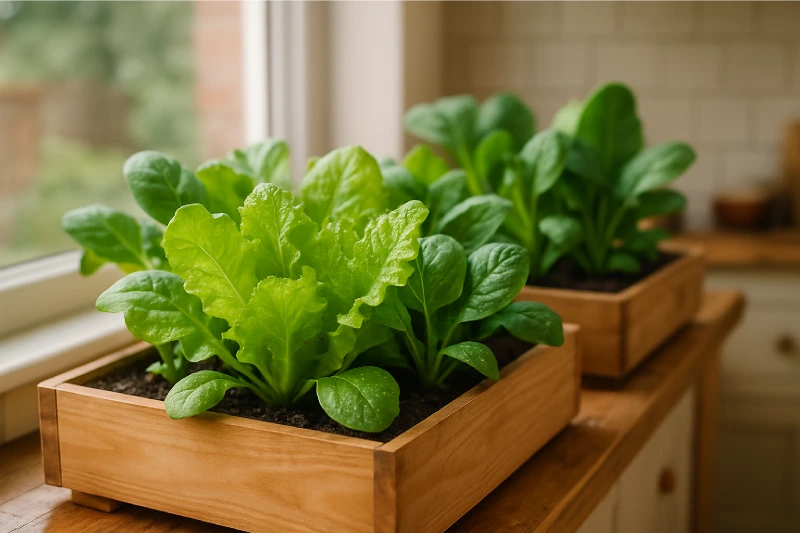
I’ll never forget the first time I harvested a bowl of crisp lettuce from my kitchen windowsill in the middle of January. It was snowing outside, the grocery store salad greens looked tired and wilted, and there I was, snipping fresh, vibrant leaves that had been growing just three feet from my sink. That moment changed how I thought about food, seasonality, and what’s possible in a small indoor space.
Growing lettuce and spinach indoors isn’t just possible—it’s remarkably easy, incredibly rewarding, and once you get the rhythm down, you’ll wonder why you ever relied entirely on store-bought greens. This guide will take you from complete beginner to confident indoor gardener, with everything I’ve learned through years of trial, error, and eventually, abundant success.
Why Grow Lettuce and Spinach Indoors?
Before we dive into the how, let’s talk about the why, because understanding the benefits kept me motivated through my early learning curve.
Year-round harvests regardless of weather. This is the obvious one, but it’s transformative. I live where winters are harsh, and fresh, local greens disappear from farmers markets for months. Indoor growing freed me from that limitation entirely. I now have fresh salads in December, January, and February without relying on greens shipped thousands of miles.
These greens are genuinely beginner-friendly. I’ve grown dozens of crops indoors, and lettuce and spinach remain the most forgiving and fastest to reward you. They germinate quickly, grow fast, tolerate minor mistakes, and don’t require perfect conditions. If you’ve killed houseplants before, don’t let that discourage you—these are different.
Space efficiency is remarkable. You don’t need a sprawling garden or even a balcony. I’ve successfully grown enough lettuce for weekly salads in a 2×3 foot space on a shelf with a simple grow light. One small corner of your home can produce a surprising amount of food.
The quality is unmatched. Store-bought greens are often a week or more old by the time you eat them. They’ve been harvested, processed, packaged, shipped, and stored. Mine go from plant to plate in under a minute. The difference in flavor, texture, and nutritional content is striking. I can actually taste the difference—homegrown lettuce is sweeter, crisper, and more complex.
You gain complete control and transparency. This matters more to me now than when I started. I know exactly what’s touched my food because I’m the one growing it. No mystery pesticides, no fungicides, no unknown chemicals. I choose organic seeds and soil, and that’s it. In a world where we’re increasingly concerned about contaminants and provenance, this peace of mind is valuable.
Understanding Your Greens: Lettuce vs Spinach
While lettuce and spinach can be grown together and share many requirements, understanding their differences helps you optimize for each.
Lettuce is faster and more forgiving. Most lettuce varieties are ready to harvest in 30-50 days from seed, with baby greens available even sooner. Lettuce handles warmer indoor temperatures better (though it still prefers cool conditions), germinates easily, and bounces back from minor neglect. I recommend starting with lettuce for your first indoor crop.
Spinach is slightly more particular but incredibly productive. Spinach takes 40-60 days to full maturity but can be harvested as baby spinach much earlier. It’s more sensitive to temperature—too warm and it bolts quickly. It also prefers slightly cooler conditions than lettuce. However, once established, spinach produces abundantly and the leaves are more substantial, so fewer plants feed you.
Growth habits differ. Lettuce forms rosettes of leaves spreading outward from a central point. Some varieties form loose heads, others stay as individual leaves. Spinach grows upright with leaves on stems emerging from a central crown. This means spinach can be planted slightly closer together than heading lettuce varieties.
Flavor profiles matter for planning. Lettuce ranges from mild and sweet (butterhead varieties) to slightly bitter (some romaines) to peppery (certain loose-leaf types). Spinach has that characteristic mineral, earthy flavor that intensifies as leaves mature. I grow both because they serve different culinary purposes—lettuce for delicate salads, spinach for heartier dishes, smoothies, and cooked applications.
Best Varieties for Indoor Growing
Not all varieties perform equally well indoors. After growing dozens of cultivars, these are my most reliable performers.
For Lettuce:
Butterhead varieties are my top recommendation for beginners. ‘Buttercrunch’ and ‘Tom Thumb’ form small, loose heads perfect for indoor spaces. They’re heat-tolerant, slow to bolt, and incredibly tender. ‘Tom Thumb’ is especially good for small spaces—the entire head is about the size of a softball.
Loose-leaf lettuces are the most productive. ‘Black Seeded Simpson’, ‘Red Sails’, ‘Oak Leaf’, and ‘Salad Bowl’ varieties don’t form heads, which means you can harvest outer leaves continuously while the center keeps producing. I’ve kept single plants producing for three months with this method. ‘Red Sails’ adds beautiful color with burgundy-red leaves.
Romaine works if you have height. ‘Little Gem’ is a compact romaine perfect for indoors, reaching only 6-8 inches tall. Standard romaine varieties can grow quite tall and may become unwieldy indoors, though they’re not impossible.
Avoid crisphead (iceberg) lettuce. These require very specific cool temperatures, take forever to mature, and are the most challenging to grow well. I spent months struggling with iceberg before accepting it’s not worth the effort indoors.
For Spinach:
‘Space’ and ‘Bloomsdale’ are workhorses. ‘Space’ is a smooth-leaf variety that’s fast-growing and slow to bolt. ‘Bloomsdale Long Standing’ is a classic savoy (crinkled leaf) type that’s productive and flavorful. Both handle indoor conditions well.
‘Tyee’ is my go-to for challenging conditions. It’s extremely bolt-resistant and handles temperature fluctuations better than most. If your indoor space gets warmer than ideal, ‘Tyee’ will forgive you.
Baby leaf spinach mixes are excellent for continuous harvesting. These are bred to be harvested young and regrow quickly. Look for mixes labeled for “baby leaf” or “cut-and-come-again” production.
Asian greens are bonus options. While not technically lettuce or spinach, mizuna, tatsoi, and komatsuna grow under identical conditions and add variety. I often include them in my plantings.
Essential Equipment and Supplies
You don’t need to spend a fortune, but having the right basics makes success much more likely. Here’s what actually matters, based on what I use and what I’ve learned you can skip.
Containers must have drainage. This is non-negotiable. I’ve used everything from proper nursery pots to recycled yogurt containers with holes drilled in the bottom. For lettuce, containers should be at least 10-15 cm (4-6 inches) deep. Spinach can handle 15-20 cm (6-8 inches). Width matters more than depth—a wide, shallow container is better than a tall, narrow one.
I prefer containers that are 25-30 cm (10-12 inches) wide so I can grow multiple plants together. My favorite setup is simple plastic nursery pots (the black ones) in 4-8 liter (1-2 gallon) sizes. They’re cheap, functional, and I can fit several on a shelf. Rectangular propagation trays (25×50 cm / 10×20 inches) with drainage holes are also excellent—you can grow 6-12 lettuce plants in a single tray.
Soil quality matters more than you’d think. I learned this the hard way after mediocre results with cheap potting soil. Invest in good quality potting mix designed for containers. I use organic potting soil that contains peat moss or coir, perlite for drainage, and some compost. Brands like Fox Farm Ocean Forest, Espoma Organic Potting Mix, or even Miracle-Gro Organic (if that’s what’s available) work well.
Avoid garden soil or topsoil—they’re too heavy and compact in containers. Avoid mixes with water-retaining crystals for greens; they can keep things too wet. I add extra perlite (about 10-20% by volume) to improve drainage and aeration.
Lighting is where most beginners struggle. Natural light alone works only if you have a very bright south-facing window and even then, results are hit-or-miss. I resisted grow lights for months, trying to make windowsill growing work, and my plants were consistently leggy, slow, and disappointing.
Grow lights changed everything. The good news: you don’t need expensive, complicated systems. Simple LED grow lights are affordable, energy-efficient, and highly effective. I use basic full-spectrum LED shop lights (the 120 cm / 4-foot T5 or T8 style) that cost $25-40 / £20-35 / €25-40 each. They plug into regular outlets and each light can illuminate a 60×120 cm (2×4 foot) growing area.
Look for lights rated at least 2000-4000 lumens and labeled “full spectrum” or showing a color temperature of 5000-6500K. Higher wattage is better—aim for 20-40 watts for a 60×120 cm (2×4 foot) area. Some people use specialized “grow light” fixtures with red and blue LEDs; these work but aren’t necessary. Regular full-spectrum white LEDs work beautifully.
Position lights 10-15 cm (4-6 inches) above your seedlings, raising them as plants grow. The closer the light (without burning), the stockier and healthier your plants will be. I keep lights 15-30 cm (6-12 inches) above mature lettuce and spinach.
Watering tools should be gentle. A watering can with a narrow spout or a simple squeeze bottle works well. I use a small plastic pitcher that gives me control. Avoid strong streams that disturb soil or knock over seedlings. Some people use spray bottles for seedlings, but I find these tedious for anything beyond the first few days.
Seeds vs seedlings: I always use seeds. Seeds are dramatically cheaper, give you more variety options, and with greens that grow this fast, there’s no real time savings from buying seedlings. A $3 / £2.50 / €3 packet of lettuce seeds can produce 50+ plants. Seeds also store for years if kept cool and dry, so you can grow multiple crops from one purchase.
Buy from reputable sources: Johnny’s Seeds, Territorial Seed Company, Baker Creek, or even reliable grocery store seed racks. Check the germination date—fresher is better, though lettuce and spinach seeds remain viable for 3-5 years if stored properly.
Optional but helpful equipment:
A small fan improves air circulation and strengthens plants. I run a basic desk fan on low for a few hours daily.
A timer for your grow lights is incredibly convenient. I set mine for 12-14 hours daily and forget about it. Basic plug-in timers cost $10-15 / £8-12 / €10-15.
Liquid fertilizer will be needed eventually. I use fish emulsion or a balanced organic fertilizer diluted to half-strength.
A humidity gauge helps you monitor conditions, though it’s not essential. Lettuce and spinach are tolerant of average home humidity.
Setting Up Your Indoor Growing Space
Location matters more than I initially realized. A poorly chosen spot will make everything harder, while the right location makes growing almost effortless.
Light is the primary consideration. If using natural light exclusively, you need a south-facing window (north-facing in the Southern Hemisphere) with at least 6 hours of direct sun. East or west windows can work for lettuce if they’re bright, but spinach may struggle. North windows (in Northern Hemisphere) are generally too dim.
If using grow lights—which I strongly recommend—placement is flexible. I grow on wire shelving units in a spare room corner, in my basement, and on a kitchen counter. The beauty of grow lights is you can grow anywhere with an electrical outlet.
Temperature is the second factor. Lettuce and spinach are cool-season crops. Ideal temperature ranges are 15-21°C (60-70°F) for lettuce and 10-18°C (50-65°F) for spinach. They’ll tolerate 7-24°C (45-75°F) but grow best in cooler conditions. Temperatures above 24°C (75°F) cause both to bolt (flower and go bitter) quickly.
Most homes are slightly too warm for optimal growth, which is why these greens often perform best in cooler rooms, basements, or during winter months when indoor heating isn’t cranked high. I grow in my basement where temperatures naturally stay around 15-18°C (60-65°F). If growing in a warm room, expect faster bolting and plan for more frequent succession planting.
Humidity is less critical but worth considering. Average home humidity (40-60%) works fine. Very dry air (below 30%) can stress plants slightly, while very humid conditions (above 70%) can encourage fungal issues. I’ve never had problems with typical home humidity levels.
Ventilation prevents disease and strengthens plants. Stagnant air encourages damping off (a fungal disease) and weak, floppy growth. I run a small fan on low for 2-4 hours daily, positioned so it creates gentle air movement without directly blasting plants. This simulates outdoor breezes and results in sturdier stems.
My personal setup: I use a 4-shelf wire shelving unit (the kind from hardware stores) in a corner of my basement. Each shelf holds 2-4 trays of greens. I mounted LED shop lights to the underside of each shelf, suspended by chain so I can adjust height. A small oscillating fan sits on the floor, aimed generally toward the shelves. A power strip with a timer controls all the lights. Total investment was under $200 / £165 / €185, and I can grow enough greens for 2-3 people year-round.
Step-by-Step: Planting from Seed
This is where your indoor garden actually begins. Take your time with these steps—getting them right sets you up for success.
Prepare your containers. Ensure they’re clean and have drainage holes. I fill containers with moistened potting soil, leaving about 1 cm (half an inch) of space at the top. The soil should be damp but not soggy—like a wrung-out sponge. If your potting mix is dry, moisten it in a separate container before filling pots, which is easier than trying to wet it after.
Direct sowing is my preferred method. I plant seeds directly in the final container rather than starting in seed trays and transplanting. Lettuce and spinach both handle transplanting, but direct sowing is simpler and reduces stress on plants.
Spacing depends on your harvest method. For full-sized heads, follow seed packet instructions—usually 10-15 cm (4-6 inches) apart for lettuce, 7-10 cm (3-4 inches) for spinach. For baby greens harvested young, I plant much more densely—seeds about 2.5 cm (1 inch) apart. I often broadcast seeds across the soil surface and thin later.
Planting depth is shallow. Lettuce seeds need light to germinate, so barely cover them—just press them into the soil surface and sprinkle a very thin layer (3 mm / 1/8 inch) of soil over them. Spinach seeds are larger and should be planted slightly deeper—about 6-12 mm (1/4 to 1/2 inch) deep.
My technique: I make shallow furrows with my finger, sprinkle seeds along the furrow (I’m not overly precise—this isn’t surgery), cover lightly with soil, and pat down gently to ensure seed-to-soil contact. Then I water very gently with a fine mist or slow trickle.
Initial watering is critical. The soil surface must stay consistently moist until germination. I check twice daily and mist if the surface looks dry. Once you see sprouts, you can reduce watering frequency. This initial constant moisture is probably the most important factor in germination success.
Cover for humidity (optional but helpful). I sometimes cover containers with clear plastic wrap or humidity domes until germination. This maintains moisture and speeds germination. Remove the cover as soon as you see sprouts to prevent damping off.
Germination timeline: Lettuce typically germinates in 2-7 days, often within 3-4 days under good conditions. Spinach is slower—7-14 days, sometimes up to 21 days if conditions aren’t ideal. Spinach seeds have a harder coat and benefit from soaking in room-temperature water for 12-24 hours before planting, which I now do routinely.
Light immediately upon germination. The moment you see green, get those seedlings under light—either in your brightest window or under grow lights positioned 10-15 cm (4-6 inches) above. Delayed light exposure causes legginess within hours.
Thinning seedlings. Once seedlings have their first true leaves (the second set of leaves that appear), thin them to proper spacing. I use scissors to snip unwanted seedlings at soil level rather than pulling them up, which can disturb neighboring roots. Those thinned seedlings are edible—your first micro-harvest.
For baby greens, I often don’t thin at all, just harvest the entire dense planting when leaves are 5-7 cm (2-3 inches) tall. For full-sized plants, I thin to final spacing: 10-15 cm (4-6 inches) for lettuce, 7-10 cm (3-4 inches) for spinach.
Daily and Weekly Care Routines
Once seedlings are established, ongoing care is straightforward. Consistency matters more than perfection.
Watering is your primary task. Greens need consistent moisture—not waterlogged, but never completely dried out. I check soil daily by sticking my finger 2-3 cm (an inch) deep. If it feels dry, I water thoroughly until water drains from the bottom. If still moist, I skip watering.
In my conditions, seedlings need water daily or every other day. Mature plants in larger containers might go 2-3 days between waterings. Factors affecting frequency: container size, plant size, temperature, humidity, and light intensity. You’ll quickly develop a feel for your specific setup.
How I water: I water until I see water running from drainage holes, then let containers drain completely. I never let pots sit in standing water—this causes root rot. I water early in the day so any splashed leaves dry before nighttime, which reduces disease risk.
Light timing is simple with timers. Lettuce and spinach need 12-16 hours of light daily. I run my grow lights for 14 hours. More than 16 hours can stress plants, and less than 10 hours causes slow, leggy growth. Natural light doesn’t need timing, obviously, but grow lights should be consistent.
Adjust light height as plants grow. Maintain 15-30 cm (6-12 inches) between light source and plant tops. Too close can cause heat stress (though LEDs run cool); too far causes stretching. I adjust weekly by raising lights or lowering shelves.
Temperature monitoring is passive. I simply note if my growing area feels unusually warm or cool and adjust plantings accordingly. If you’re seeing premature bolting, your space may be too warm—consider cooler locations or growing more in winter.
Fertilizing begins after true leaves appear. Potting soil contains enough nutrients for the first 2-3 weeks. After that, I fertilize every 10-14 days with liquid fertilizer diluted to half the recommended strength. I use fish emulsion (5-1-1) or an organic vegetable fertilizer. Over-fertilizing causes lush growth that’s more susceptible to pests and disease, so I err on the side of less.
Air circulation runs daily. My fan runs for 2-4 hours daily on low speed. I don’t run it constantly—plants need some still periods too. The goal is gentle movement that strengthens stems.
Rotation improves even growth. If using natural light, I rotate containers 180 degrees every few days so all sides get equal exposure. With overhead grow lights, this is less necessary, but I still rotate occasionally out of habit.
Weekly inspection catches problems early. Once a week, I closely inspect every plant. I look for yellowing leaves, pest damage, unusual growth patterns, or disease signs. Early detection makes problems much easier to address.
Troubleshooting Common Problems
Even with good care, issues arise. Here’s what I’ve encountered and how I’ve solved these problems.
Leggy, stretched seedlings are the most common beginner problem. This happens when light is insufficient. Stems become long and spindly, leaves are far apart, and plants flop over. The solution is immediate: move plants closer to light or add supplemental lighting. Prevention: ensure strong light from germination onward.
For mildly leggy seedlings, you can sometimes save them by burying stems deeper when transplanting—they’ll develop roots along the buried portion. Severely leggy seedlings are better discarded and replanted with better lighting.
Yellowing leaves have several causes. If lower leaves yellow while upper leaves remain green, this is normal aging—just remove them. If all leaves are yellowing and growth slows, suspect nitrogen deficiency—increase fertilizer frequency. If leaves yellow with green veins, it’s likely iron deficiency—adjust pH or switch fertilizers.
If yellowing is accompanied by wilting despite moist soil, you may have root rot from overwatering. Reduce watering frequency immediately and improve drainage.
Bolting (premature flowering) is frustrating but manageable. Plants send up a flower stalk, leaves become bitter, and growth stops. Causes: temperatures too warm, plants too mature, or day length too long (less common indoors with artificial light).
Prevention is key: grow during cooler months, harvest regularly, choose bolt-resistant varieties, and maintain temperatures below 21°C (70°F) if possible. Once a plant bolts, pull it and plant new seeds—there’s no reversing it. The good news: lettuce and spinach bolt individually, not all at once, so it’s a gradual process.
Slow growth usually means insufficient light or cold temperatures. If plants are otherwise healthy but just growing sluggishly, increase light intensity or duration. Check that temperatures aren’t dropping below 10°C (50°F) at night. Also verify you’re fertilizing adequately.
Bitter taste in lettuce comes from heat stress, insufficient water, or bolting. Harvest in the morning when plants are coolest. Ensure consistent watering. If persistently bitter despite good care, the variety may not be well-suited to your conditions—try a different cultivar.
Aphids can appear even indoors. These tiny insects cluster on new growth, sucking sap and weakening plants. They’re usually brought in on contaminated potting soil or through open windows. I’ve dealt with aphids by spraying plants with a strong stream of water to dislodge them, then following up with insecticidal soap every few days until gone. Neem oil also works but smells terrible indoors.
Prevention: inspect new plants and soil before bringing them to your growing area, maintain good air circulation, and check plants regularly.
Fungus gnats are annoying but mostly harmless. These tiny flying insects live in moist soil. Adults are nuisances; larvae can damage roots in large numbers. They indicate overwatering. Reduce watering frequency, let soil surface dry between waterings, and add a layer of sand on top of soil to disrupt their lifecycle. Yellow sticky traps catch adults.
Damping off kills seedlings at soil level. Affected seedlings suddenly collapse and die. This fungal disease thrives in cold, wet, poorly ventilated conditions. Prevention: don’t overwater, ensure good air circulation, use sterile potting mix, and avoid planting seeds too densely. Once it strikes, there’s no cure—remove affected seedlings immediately and improve conditions for survivors.
Powdery mildew appears as white, powdery patches on leaves. It’s caused by high humidity and poor air circulation. Increase air movement with a fan, space plants further apart, reduce humidity if possible, and remove affected leaves. Spray remaining plants with a baking soda solution (1 tablespoon per quart of water) or diluted milk (1 part milk to 9 parts water) weekly until resolved.
Tip burn (brown leaf edges) in lettuce usually results from calcium deficiency or inconsistent watering causing nutrient uptake issues. Ensure even moisture levels and consider adding a calcium supplement (crushed eggshells work slowly; liquid calcium is faster).
Harvesting for Continuous Production
Proper harvesting techniques can extend your harvest period from weeks to months. This is where indoor growing really shines.
Start harvesting early. You don’t need to wait for full maturity. Baby greens are delicious and harvesting young encourages continued production. I start snipping lettuce leaves when they’re 7-10 cm (3-4 inches) long, usually 3-4 weeks after germination. Spinach can be harvested even younger—2-3 weeks for baby spinach.
The cut-and-come-again method is transformative. Instead of harvesting entire plants, I harvest outer leaves while leaving the central growing point intact. The plant continues producing new leaves from the center for weeks or even months. I’ve kept individual lettuce plants producing for 10-12 weeks this way.
How I harvest: I use clean scissors and cut leaves about 2.5 cm (an inch) above the soil line. I take the largest outer leaves first, leaving smaller inner leaves to continue growing. I never take more than one-third of the plant at a single harvest. For a mature lettuce plant, I might harvest 4-6 leaves every 4-5 days.
Harvest timing affects quality. Morning is best—leaves are crisp and full of moisture. By afternoon, especially under lights, leaves can be slightly wilted. The difference is subtle but real.
Entire head harvesting is simple but ends production. If you want a full lettuce head, let it develop to maturity (usually 45-60 days), then cut at the base. Some varieties will regrow from the stump if you leave 2.5 cm (an inch) of stem, though regrowth is usually weaker than the original plant.
Spinach harvesting is slightly different. Individual spinach leaves grow on stems from a central crown. I harvest by cutting individual leaf stems near the base. The crown continues producing new leaves. Spinach is remarkably productive this way—a single plant can give multiple harvests over 6-8 weeks.
Watch for flower stalks and remove immediately. If you see a thick stem forming in the center of your lettuce or spinach, that’s a flower stalk. Pinch or cut it off immediately. This delays bolting and extends harvest time, though eventually the plant will bolt despite your efforts.
Storage after harvest: Rinse leaves immediately in cool water and dry thoroughly (salad spinners work great). Store in the refrigerator in a container with a paper towel to absorb moisture. Home-grown lettuce and spinach stay fresh for 5-7 days, much longer than I expected.
Knowing when to give up: Eventually, every plant exhausts itself or bolts. When production slows dramatically, leaves become small and bitter, or flower stalks keep appearing despite removal, it’s time to harvest any remaining edible leaves and pull the plant. Compost it and plant the next round.
Succession Planting for Non-Stop Greens
The key to continuous harvests is never relying on just one planting. Succession planting sounds complicated but it’s actually simple once you establish the rhythm.
The principle is straightforward: Start new plants every 2-3 weeks so as older plants decline, younger plants are reaching peak production. This gives you a constant supply rather than feast-or-famine cycles.
How many plants to grow at once depends on consumption. My household of two eats salad 4-5 times per week. I maintain 12-15 lettuce plants in various stages and 6-8 spinach plants. This gives us consistent harvests with occasional extras. A family of four eating daily salads might want 20-25 lettuce plants staggered across 3-4 different plantings.
My planting schedule: I plant new seeds every 2 weeks. I have four containers in rotation, each at a different stage. At any given time, I have seedlings, young plants, mature plants in peak production, and aging plants being harvested heavily before removal. Every 2 weeks, I pull the oldest container, thoroughly clean it, add fresh soil, and start new seeds.
Track your plantings. I use a simple notebook or phone note with dates planted and variety names. After months of planting, it’s impossible to remember which container was planted when without records.
Adjust frequency based on results. If you’re running out of greens before the next harvest is ready, decrease time between plantings. If you’re overwhelmed with greens, increase the interval. I started planting every week, found that too much, and settled on every 2 weeks.
Consider varying varieties. Each planting doesn’t need to be the same. I rotate between different lettuce types—one planting might be butterhead, the next loose-leaf, the next romaine. This provides variety and helps me learn which cultivars perform best in my conditions.
Seasonal adjustments matter even indoors. In summer, my basement stays warmer and greens bolt faster, so I plant smaller amounts more frequently and focus on heat-tolerant varieties. In winter, cooler temperatures extend harvest periods, so I can plant larger amounts less frequently.
Advanced Tips for Maximum Success
After years of growing, these refinements have noticeably improved my results.
Light intensity matters more than duration. Running weak lights for 16 hours is less effective than strong lights for 12 hours. If plants are leggy despite long light exposure, you need more intense light, not longer periods. I upgraded from basic shop lights to higher-output LED grow lights, and plant quality improved significantly despite shorter daily photoperiods.
Soil refreshment between plantings is worth the effort. I used to reuse potting soil multiple times, and plants declined with each cycle as nutrients depleted and soil structure degraded. Now I refresh soil between plantings by mixing in 25-30% fresh potting soil and a handful of compost. Plant vigor improved noticeably.
pH affects nutrient availability. Lettuce and spinach prefer slightly acidic to neutral pH (6.0-7.0). If you’re having unexplained issues despite good care, test your soil pH with an inexpensive kit. I discovered my water was quite alkaline, gradually raising soil pH above 7.5. Adding sulfur to lower pH solved persistent yellowing issues.
Microclimate creation improves results. Grouping plants together creates a more humid microclimate than isolated pots. I cluster containers on trays, which allows me to water the entire tray at once while keeping plants in their beneficial microclimate.
Experiment with container depth. Conventional wisdom says lettuce needs 10-15 cm (4-6 inches) of soil depth. I’ve experimented with deeper containers (20-25 cm / 8-10 inches) and found plants grow larger with longer harvest periods. The extra soil holds more moisture and nutrients, requiring less frequent watering and fertilizing. If you have space for deeper containers, it’s worth trying.
Succession planting within containers extends harvest. In a large container, I sometimes plant half densely for baby greens and half at proper spacing for full-sized plants. This gives two harvest timelines from one container.
Temperature manipulation extends seasons. When greens start bolting in my warmer months, I move containers to my coolest indoor location—a north-facing closet with a grow light. The 3°C (5°F) temperature reduction delays bolting for weeks.
Red-pigmented varieties may have higher nutritional content. This isn’t strictly about growing success, but varieties with red or dark purple pigmentation (like ‘Red Sails’ lettuce or ‘Red Kitten’ spinach) contain anthocyanins with antioxidant properties. They also add beautiful color to salads. I always include at least one red variety in my plantings.
Harvest stress promotes flavor intensity. This is counterintuitive, but slightly stressed plants often have better flavor. Letting soil dry slightly between waterings (without wilting plants) seems to concentrate flavor. I don’t deliberately stress plants, but I’ve noticed plants that occasionally dry a bit have more character than pampered, constantly moist plants.
The True Value: Beyond Cost Savings
Let’s talk about what this really costs and what it’s actually worth, because the full picture is more complex and more compelling than simple dollars and cents.
Initial investment breakdown:
- Basic setup (containers, soil, seeds): $30-50 / £25-40 / €30-50
- Simple grow light system: $40-80 / £35-65 / €40-75
- Optional timer and fan: $20-30 / £15-25 / €20-30
- Total: $90-160 / £75-130 / €90-155 to get started
This assumes a modest setup growing 10-15 plants. You can start cheaper with found containers and natural light, or spend more on larger, more sophisticated setups.
Ongoing costs per year:
- Seeds: $15-25 / £12-20 / €15-25 (multiple varieties, enough for dozens of plantings)
- Potting soil: $30-50 / £25-40 / €30-50 (depends on whether you refresh completely or partially)
- Fertilizer: $10-20 / £8-15 / €10-20 (one bottle lasts months)
- Electricity for grow lights: $30-60 / £25-50 / €30-55 per year (LED lights running 14 hours daily use approximately 50-100 kWh annually at average electricity rates)
- Total: $85-155 / £70-125 / €85-150 per year
Yield expectations and monetary value:
A single mature lettuce plant yields 115-225 g (4-8 ounces) of leaves over its lifetime. With continuous harvest, you might get 340-450 g (12-16 ounces) before the plant exhausts. If you maintain 12-15 plants in rotation, you’re harvesting roughly 900 g-1.8 kg (2-4 pounds) of lettuce weekly.
Store-bought organic mixed greens cost $9-18 per kg / $4-8 per pound / £6-12 per kg / €7-14 per kg in my area. Growing your own produces roughly 45-90 kg (100-200 pounds) annually (depending on dedication and space), equivalent to $400-1,600 / £350-1,350 / €400-1,500 worth of store-bought greens.
But monetary value misses the real point.
You know exactly what touched your food. Store-bought greens have unknown histories. What pesticides were used? What was in the wash water? How was soil treated? I use organic soil and seeds, and nothing else touches my plants. In an era of increasing concern about chemical residues, this transparency is genuinely valuable.
Microplastic exposure is dramatically reduced. Research increasingly shows microplastics contaminate our food supply through multiple pathways—plastic packaging, processing equipment, contaminated water used for irrigation and washing, and environmental pollution in growing fields. Store-bought greens come in plastic clamshells, are processed on plastic equipment, and may be grown in soil contaminated with microplastics from atmospheric deposition and irrigation water.
Home-grown greens eliminate packaging plastics entirely. While you can’t eliminate all microplastic exposure (they’re in water and air), you’re removing major contamination pathways. Every salad I harvest goes from plant to bowl with zero plastic contact. That matters to me, especially for foods my family eats multiple times weekly.
Carbon footprint is virtually eliminated. Store-bought lettuce often travels 2,400+ km (1,500+ miles) from California or Arizona to reach my table. It’s grown in massive operations, refrigerated through transport, stored in cooled warehouses, and kept cold at retail. The carbon footprint is substantial. My lettuce travels less than a meter (three feet) from shelf to kitchen. The only energy input is LED grow lights, which in my setup use about the same electricity as leaving a laptop running.
Nutritional superiority of immediately harvested greens. Vitamins degrade from the moment produce is harvested. Studies show leafy greens lose 10-50% of vitamin C and other nutrients within the first week after harvest. Store-bought greens are typically 5-14 days old when you buy them. Mine are harvested minutes before eating. The nutritional difference is real, though hard to quantify personally.
Food safety is in your control. Recall after recall affects store-bought lettuce and spinach—E. coli, listeria, salmonella contamination from irrigation water, processing facilities, or field conditions. When you grow your own, you control every variable. My greens have never made anyone sick because I’m the only one handling them, and I control sanitation.
The mental health and connection benefits are real. This sounds abstract, but growing food—even in small amounts—reconnects you to natural cycles in a way that’s genuinely grounding. In winter, when everything outside is dormant, I have vibrant green life thriving under my care. That matters for mental wellbeing in ways I didn’t anticipate when I started.
Long-term health investment perspective: If eating fresh, uncontaminated greens multiple times weekly for years reduces disease risk or improves health outcomes even marginally, what’s that worth? This isn’t quantifiable on a spreadsheet, but it’s arguably the most valuable aspect. I think of it as a very small investment in long-term health.
The hidden costs of store-bought produce: When you factor in driving to the store (time, gas, wear on vehicle), the packaging waste you’re bringing into your home, and the reality that store-bought greens often spoil before you use them (wasted money), home growing becomes even more attractive. I used to throw away half my lettuce clamshells because they’d go slimy before I used them. That waste is eliminated—I harvest exactly what I need.
Bottom line: On pure dollar cost, you might break even or save a bit depending on how much you currently spend on greens. But when you account for quality, food safety, reduced contamination, environmental impact, and health benefits, the value equation shifts dramatically. I’d grow lettuce and spinach indoors even if it cost more than buying them, because the non-monetary benefits are significant.
Final Thoughts: Your Indoor Garden Journey
Looking back at my years of growing lettuce and spinach indoors, I’m struck by how transformative such a simple practice has been. What started as curiosity about whether I could grow food indoors became a fundamental shift in how I relate to food.
You’ll make mistakes. Your first planting might be leggy or bolt quickly or struggle in ways you don’t immediately understand. That’s normal and part of learning. I killed countless seedlings, dealt with mysterious yellowing, battled aphids, and watched plants bolt just as they reached perfect harvest size. Each problem taught me something.
Start small. One container of lettuce. One simple grow light. Get comfortable with that before expanding. The beauty of this method is its scalability—you can grow a single pot on a windowsill or dedicate an entire room to indoor greens. Begin where you’re comfortable.
Keep notes. I cannot emphasize this enough. Record what you plant, when you plant it, varieties used, problems encountered, and harvest dates. After several cycles, patterns emerge. You’ll discover which varieties thrive in your conditions, optimal spacing for your containers, and the perfect succession planting schedule for your household.
Be patient with yourself and the process. Growing food—even fast-growing greens—requires time. Seeds take days to germinate, weeks to reach harvest size. In our instant-gratification world, this patience is actually part of the value. Watching daily progress is meditative and grounding.
Enjoy the learning curve. Every growing cycle teaches something new. I’m still learning after years of practice. I recently discovered that slightly cooler temperatures produce sweeter lettuce. I’m experimenting with mixed plantings of lettuce and spinach in single containers. I’m testing new varieties constantly. The learning never stops, and that’s part of what keeps it interesting.
Share your harvest. Once production ramps up, you’ll have more greens than you can eat. Share with neighbors, friends, and family. There’s genuine joy in handing someone a bag of fresh lettuce you grew and watching their surprise at the quality. It often inspires others to try growing their own.
Remember why you’re doing this. On frustrating days when seedlings die or aphids appear or plants bolt unexpectedly, reconnect with your motivation. For me, it’s the satisfaction of growing genuinely clean food for my family, the environmental benefit of reducing my food system footprint, and the simple pleasure of eating something I nurtured from seed to plate.
Your first crisp, sweet lettuce salad harvested from your kitchen will make it all worthwhile. That moment when you realize you’ve closed the loop—seed, soil, light, water, and your care transformed into nourishing food—is genuinely powerful. It’s not just about salad. It’s about capability, connection, and taking back a small measure of control in an increasingly complex food system.
Start today. Plant seeds this week. In a month, you’ll be harvesting your own lettuce and spinach, and in six months, you’ll wonder why you ever relied entirely on store-bought greens. The investment is modest, the learning curve is manageable, and the rewards—tangible and intangible—are substantial.
Welcome to indoor growing. Your garden awaits.